On Friday, April 25, 1924, the Seattle PCL ball club played the 16th overall game in what was their third series of the year. In the PCL of the time, a given series between teams lasted Tuesday/Wednesday to Sunday/Monday, so this was also the third week of the season. Generally, there were 7 games to a series, minus rain-outs, train delays, etc.
The Indians made it three straight against the Sacramento Senators, winning by a score of 9 to 1 behind the strong pitching of George Steuland, some great leadoff hitting from center-fielder Billy Lane, a massive home run from big first baseman Elmer Bowman, and the good eye of Ray Rohwer, who went 0 for 0, yet managed a 1.000 OBP.
This is the game where the Indians pulled themselves out of the PCL basement and began their long climb towards catching the first place San Francisco Seals. They tied the Solon victory total at six, but thanks to poor weather in Salt Lake, the Indians had played a game less than Sacramento, thus eeking out a lead over that now last place team by the percentages, the Seattle 6-10 record being a .375 winning percentage compared to the .353 of the 6-11 team on the losing side of this days game. This is an essential feature of the Coast League of the time. Practically, each team will end up playing a differing number of games over the course of a season, between 196 and 210 usually. The main difference will be winning percentage, not overall wins and losses.
Ray Rohwer had a unique if not an extraordinary game, going 0-0 with 4 walks. He was in the middle of a three game stretch where he would get on base in 13 consecutive plate appearances. I’m not sure if there is an accurate PCL record for this time, when it was classified as a AA league, but 13 is a pretty good stretch. Hitting streaks were pretty well accounted for, but an on-base streak was not looked upon as kindly, and, without really knowing at all, I would guess Rohwer’s streak to be one of the better in PCL history. The longest such streak in MLB history is 17.
Rowher was born in Dixon, California in 1895. The Rohwer family, Jacob and Lena were his parents, were quite productive, accounting for at least four members of the 1916 Dixon Dairy City baseball team. In the picture to the right, Hans Rohwer is in the upper left, Ray is in the middle on the right, Eggert Rohwer is in the middle on the end, and Claude Rohwer is in the lower row in the middle. Ray would be the only one of these to make the major leagues. Ray went on to star at the University of California, graduating in 1917. Following that he went to officer training in France during World War I where he received a Lieutenant commission in August 1918. I’m not sure about college eligibility rules related to WWI, but it seems he came back to play some games in 1920 at Berkeley. From there he went to the Pittsburgh Pirates for parts of 1921 and 1922, and was then traded to Seattle. He would continue to have a great year in 1924, but would be traded in the off-season prior to 1925 for third basemen Frank Brazill from Portland. Eventually, he would wind up his career with Sacramento, near his hometown, retiring after 5 ½ years there in 1931.
Rohwer, or rather the Rohwers, still played baseball though. I found a box score from a Woodland newspaper from 1933. It details a game between the Dixon Packers and Woodland Oaks, and Ray Rohwer was still making a difference with his bat. The 3-4-5 hitters were Claude, Ray and Eggert Rohwer, and they helped the Packers take this particular Valley League contest that day by a score of 3-2. At least one other brother, Otto, also played baseball for the UC Bears, being listed on the team in 1925-27. Otto later became a lawyer and was president of the Sacramento Chamber of Commerce when they sued in 1944 to keep the Sacramento ball club from being sold to out of town interests.
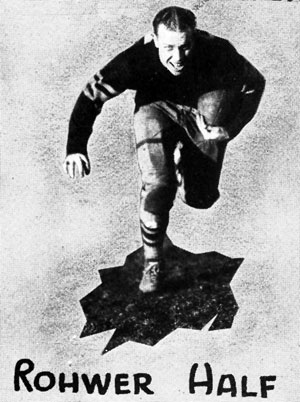
As a total aside, but to provide complete coverage on all known professional baseball players in the US with a last name of Rohwer, I know the guy to the right is related, probably a Rohwer cousin since he was in high school in Spokane while Claude and Ray were competing against each other in the PCL (I don’t have the exact information but rather genealogical references), there is also a Ted Rohwer who was a half-back at Washington State University from 1926-28 (see right). He had pitched in two games in the minors in Illinois in 1930. For his collegiate endeavors, Ted Rohwer was elected to the WSU Hall of Fame in 1989.
Claude Rohwer, who also left the University of California to serve in WWI, and was invited to Pittsburgh Pirates training camp in 1922 only to lose the third base job to fellow prospect Pie Traynor, was done with PCL ball by 1924, became Commander of the Dixon American Legion post by 1932, and died in car accident in 1940. Ray lived until 1988, passing away in Davis, California. Even though having a game with no at-bats but four walks is unique, Ray had an even more unique game on August 23, 1927, when his Sacramento team was visiting Los Angeles. Ray went 0-0 again, but had 4 sacrifice hits, 1 walk and 1 HBP.
Also of note here is supposedly only the third ball ever hit out over the right field fence by a right handed hitter. I’ve been looking for a picture of the field from that time to gauge an idea of the size of the park. Also, I haven’t been able to find a game description of either Kamm’s or Meusel’s home runs, but I’m searching. Once again, hot off the presses of the Seattle Daily Times, from one of up to seven daily editions, a transcription of a dusty, faded day:
Indians Continue To Bunch Their Hits To Beat Sacramento
Bowman Drives Out Homer Clearing Right Field Wall for One of Longest Blows in Seattle’s History
THREE straight for the Seattle tribe of Indians is the score today in this first series at home with Sacramento as the result of a finely pitched ball game turned in by George Steuland and some more lusty hitting by his mates. The score was Seattle, 9; Sacramento, 1.
Steuland now ranks with Suds Sutherland for the honor of the best pitched games of the year. Suds held Los Angeles to one run in the Sunday doubleheader there.
Steuland pitched a beautiful game. And his mates backed him up in perfect style, nary a bobble occurring behind him while a snappy double play he engineered with Sam Crane and Bowman in the first inning helped him out of one of the two holes he got into by putting the first man on base.
Stingy With Hits
The big Dakotan allowed but six hits. Kopp singled as first man up and was snagged in that aforementioned double play. Cochrane walked in the second, but he got no further, Mollwitz and McNeeley lifting towering flies.
Hughes singled as second man in the third inning, but Kopp lofted to Ray Rohwer and Claude Rohwer fanned on three pitched balls, two beautiful tantalizing curves and a fast one through the heart.
Steuland balked the only run in for Sacramento in the fourth. Siglin walked, advanced on an infield out and then Cochrane also walked, Mollwitz forced Cochrane, Siglin taking third and the pair started a double steal. Steuland gave Mollwitz a big lead, stopped his pitch and threw to get Siglin, who was allowed to score unmolested. McNeeley grounded out to end that trouble.
Steuland retired the side in the fifth, seventh and eighth. He had two men on from singles in the sixth, but fanned Mollwitz for the third out. Cochrane and McNeeley singled in the ninth, but Schang, sent in as a pinch-hitter, lofted to Ray Rohwer and the victory was won.
Just One Hit Wasted
For the third straight game the Indians made every hit but one count. Eldred’s long double to right was wasted in the third inning. The nine other Indian bingles figured in the run getting some way.
Bill Hughes, who was chosen to take the punishment by Manager Charley Pick, was hit for a single by Billy Lane in the first inning. Cliff Brady bunted foul on the first ball, then with the Solon infield expecting him to bunt again, singled sharply to left field. Crane did bunt and the two midgets advanced a base each.
Brick Eldred sent a long fly to Cochrane, on which Lane scored and Brady took third. Then came the hit de luxe, Bowman’s homer over the right center field fence.
Seattle fans who have attended baseball games in Coast League park regurlarly for years have seen just three balls hit over that fence by right-handed hitters- Bob Meusel, when he was with Vernon; Willie Kamm when he was with San Francisco and then Bowman’s yesterday. There have been flies dropped over the fence close to the foul line, but Bowman’s drive cleared the Shell Oil Company’s sign in right center, traveling on a line and clearing the wall with yards to spare. It was some drive.
Hughes pitched nice ball from then on to the seventh, only Eldred’s double and bases on balls to Bowman and Rohwer in the third and a walk to Rohwer in the sixth marring his work.
The Indians came back with another of the irresistible rallies in the seventh. Steuland was out when Lane doubled to left. He stole third and scored when Koehler threw into left field.
Brady then walked and Sam Crane singled. Eldred forced Crane. Brady reaching third and scoring when Claude Rohwer kicked Bowman’s ground ball. Hughes walked Ray Rohwer for the fourth time and Ted Baldwin, whose hitting eye had been missing all week came through with a looping single to right, scoring Brick and Bowman.
Steuland’s line single to center, Lane’s blow to left, Brady’s sacrifice and Crane’s double would the Indian scoring in the eighth.
Fans Following Play
Another good week day crowd was on hand and with good weather on tap today and tomorrow the Coast League park is going to be taxed to the limit.
It has been many years since Seattle has boasted of a club with a scoring record of 120 runs in sixteen games, a fielding record of only seventeen errors in sixteen games, eight of which have been played perfectly.
And, with good pitching apparently on the road following the showings of Sutherland, Gregg, Plummer and Steuland the outlook is promising to say the least.
Lane and Rohwer Stand Out
The work of Billy Lane and Ray Rohwer since the team returned home has been little less than phenomenal.
Wednesday Lane hit three doubles, drew two walks and scored three runs.
Thursday he singled twice, doubled and sacrificed, scoring two runs in five trips to the plate.
Friday he singled twice, doubled and scored three runs.
That makes his total nine hits, five of them doubles, and eight runs for the three games.
Ray Rohwer on Wednesday sacrificed, singled and scored a run in four trips to the plate.
On Thursday he tripled twice, singled twice and walked in five trips beside scoring twice.
And yesterday he walked every time he came up, four in all.
His record shows five hits, two of them triples, five bases on balls and a sacrifice hit as well as three runs.
Yesterday he handled six fly balls in left field too.
No wonder they’re winning games.
The images of the Rohwer brothers are from the Dixon Public Library's digital archives and exhibitions. Follow the pic's to link to that. Support Public Libraries!
Game 15, in which the Seattle Indians improve to 5-10
For their 15th game of the year, the Indians sent out Bill Plummer to the mound, only to have him injure his arm and come out of the game early. Plummer, whose son Bill would go on to back up for Johnny Bench and later manage the Seattle Mariners, started pitching in the PCL at the age of 19 with Portland, then moving to Seattle for a small part of the 1923 season. In 1924, he had come out of spring training as, going by this article and previous ones, the best pitching option for the Indians. He would pitch 130 innings in 1924, followed by 142 in 1925. He sat out 1926, and then tried one last comeback on August 16, 1927 at the age of 25. He lasted 5 and 2/3 innings that day against the San Francisco Seals.
This game gave the Indians their 5th win of the year, Plummer his third. Sacramento pitcher Bill Prough took the loss. This was to be Prough’s last year in the PCL. From 1914 to 1924, he pitched nearly 3300 innings in the PCL with Oakland and Sacramento, going 175-192 with a 3.04 ERA. Overall, he had 18 minor league seasons, throwing 4676 innings in 642 games, with 269 wins and 252 defeats. Those numbers are incomplete, but only slightly since his first year with Iowa’s Keokuk Indians need to be counted up. You can add 1 major league game onto Prough’s stats, as he pitched 3 innings on April 27, 1912, for the Cincinatti Reds. He went out to the mount that day with another guy getting his cup of coffee, Hanson Horsey. Their efforts were part of a 23-4 beating at the hands of the Pittsburgh Pirates.
Sacramento Pitchers Again Maltreated By Killefer’s Larrupers
Lane, Eldred and Rohwer Account for Eleven Base Knocks-Plummer Forced to Quit With Sore Arm.
ANOTHER victory resulted for the Seattle Indians yesterday when they made all but one of seventeen hits count and defeated the Sacramento Senators, 11 to 5. It was the second straight victory of the home series for the Indians, and was witnessed by a good-sized weekday crows.
The victory was not without cost, however, for Bill Plummer, the youngster who had already accounted for two of the Indian four winning games, was forced to retire at the end of the seventh inning with a sore elbow.
So long as Plummer felt right the Senators were helpless. Earl McNeeley, Solon center fielder, was the only man to find Plummer’s delivery safely for three innings. His speed was terrific and he shot through several balls that broke a full foot and broke fast, too. His control was splendid, too, and he looked even better than he did the day he beat the Angels for Seattle’s first victory.
Plummer’s arm commenced to go bad in the fourth, however. He was found for two scratch singles, but with the bases full and the count three and two on Cochrane he curved one through the heart of the plate for a strike out and ended that trouble.
He might have escaped trouble in the fifth except that Ted Baldwin made an excusable error on a chance shot his way by McGinnis, following which Merlin Kopp spanked one over the right field wall, scoring McNeeley and McGinnis ahead of him.
Kopp drove in the other two Solon runs in the seventh but he was mighty lucky. He was falling away from a curve ball and hit in self defense, the ball dropping in right field for a double. Mollwitz had singled and McNeeley doubled ahead of Kopp’s blow.
Manager Killefer sent Carl Williams in to finish the game. Plummer looks like the best Indian pitching bet so far and no chances were taken with him.
Indians Bunch Their Blows
The way the Indians are bunching their blows is a caution. In two games at home they have wasted just one hit each.
It was the same way in training season. Let some one of them start a rally and they were as apt to bat all the way around as not. That’s what makes for winning baseball clubs.
Sand Blowers Connect
It was the sand blowers again who delivered the knockout punches for three of Col. Charles Pick’s hurlers.
Lane delivered to singles, a double, and a sacrifice fly and scored twice.
Cliff Brady delivered two singles, two sacrifices and scored a run.
Brick Eldred delivered four singles, drove in three runs and scored one himself.
Ray Rohwer delivered two triples, two singles and two runs, besides driving in another counter.
For your information a “sand blower” in the parlance of the Indian training camp, is a human being built so closed to the ground that when he takes a deep breath and expels it with force the sand flies.
Lane, Brady, Eldred and Rohwer can all walk under a bar held five feet six inches off the ground-hence the title.
Score in First Five Cantos
In every one of the first five innings Indian runs pattered across the plate.
Bill Lane started the first inning by pushing a bunt down the first base line and beating it out. Brady sacrificed and after the midget center fielder had taken third on Crane’s long fly to center, Eldred delivered his first pinch blow, Lane scoring.
Ray Rohwer punched a rousing triple to left center off Bill Prough to open the second. Ted Baldwin walked and after Earl Baldwin had fanned Bill Plummer delivered a sacrifice bunt which scored Rohwer and moved Ted Baldwin along to second. He was picked off of that bag by a quick throw from Schang.
The Solons got Lane out finally in the third, after that player had reached first base safely six consecutive times in two days, but Cliff Brady gave the Indians a start with a clean single over second.
Prough kicked Crane’s chance, then threw badly to catch Brady and both of them were safe. Eldred’s single to left scored Brady. Crane and Eldred moved up on a double steal and Crane scored on Bowman’s terrific line fly to Kopp. Ray Rohwer crashed out his second triple of the day, scoring Eldred.
Three more trickled over in the fourth. Bill Plummer began it with a rousing double to right center. Schang threw to catch him at second and nobody covered, the ball going to center field and Plummer to third. Lane doubled to left and was sacrificed along by Brady. Crane doubled to left center, scoring Lane, and scored himself on Brick Eldred’s third consecutive run producing bingle, Daka Davis, claimed by the Solons from San Francisco when the Seals asked waivers on him, did the pitching following Plummer’s blow.
Vinci, a young left-hander, stepped onto the mound in the fifth and was greeted with two more runs. Rohwer hit the first ball he threw to right for a single. Ted Baldwin forced Rohwer and Earl Baldwin was hit by a pitched a pitched ball. Plummer filled the bases with a scorching single off Siglin’s bare hand. Lane’s long fly to center allowed Ted Baldwin to score and Earl Baldwin to take third from where the latter runner scored on Brady’s single to center.
The last counter came in the eighth when Earl Baldwin doubled to left scoring Rohwer, who had singled and gone to second while Ted Baldwin was forcing Eldred at third.
Eldred earned Rohwer’s hit for him by yelling, “I have it,” in the midst of the Sacramento infield, as a result of which no one touched Rohwer’s high fly until it hit the ground.
Game 14, home opener against the Sacramento Solons
The Seattle Indians finally headed home after being away from town for a couple of months, first for Spring Training in San Bernardino and then followed by two dismal weeks to open the 1924 Pacific Coast League season. The season started first in Los Angeles and then went via train to Salt Lake City. The hometown opening day started with a rather massive and circuitous parade through downtown Seattle to the Indians home field. According to the article below, a record 14,000 fans attended the opening day game. As one of the stories put it, “IT was a “Whoop-la” “Atta Boy” day for fair at the Seattle ball yard yesterday afternoon when Radiant Red Killefer’s newly laundried Redskins took Curly Colonel Charley Pick’s bewildered Sacramento Senators and mopped up the diamond with them to the merry old tune of 9 to 2.” It’s nice to see some of the same language used today originated in the jazzy newsprint patois of the time. Its also nice to see the brutality of the society reflected in its usage of terms like Redskin, Indian, etc. The casualness of it highlights the complexity of race in the emerging America. The stands were so crowded for opening day “you couldn’t have gotten a boy-and a really small boy at that-into the grand stand with a jimmy.”
Charles Thomas Pick was born April 12, 1888, in Brookneal, Campbell County, Virginia, and he passed away on June 26, 1954 in Lynchburg, just to the north of Campbell County. Brookneal was initially founded in the early 1800s by descendents of the first white settlers of Campbell County, some were named Brook, and others Neal. John Brook's land was across the Staunton River from Patrick Henry's, and it was on Brook's side of the river that a tobacco warehouse was built, across the river from Henry's farm. It was here that Brookneal developed. Pick's younger brother Lewis was also born in Brookneal. Lewis would grow up to become a Lieutenant General and Chief Engineer of the Army Corp of Engineers. Both Pick City, North Dakota and Pickstown, South Dakota were named for Lewis A. Pick. Charlie Pick died in Lynchburg of a heart attack on Thursday, June 26, 1954. At the time of his death, Charlie had been Attendance Officer for the Rustburg School Board. Pick played in the American Legue for Washington and Philadelphia, and then in the National League for Chicago and Boston. In 1918, he split his time between the San Francisco Seals and the Cubs. The 1918 Cubs have come under suspicion for possibly having thrown that year's World Series. Please note, Charlie Pick probably had the best series of any hitter with more than 10 at-bats.
The Seattle Daily Times presented the action via a new ‘long range camera’ it called Aunt Eppie. I have searched for what camera this was, but have not gathered any solid information. I think the name is based on a character from a comic than ran on the sports pages by Fontaine Fox, called Funny Folk. I have presented one of the comics below. Fox was one of the earliest of America’s syndicated comic artists, with his work appearing from the first decade of the 1900’s into the 1950s.
I’ve also included, in addition to the pictures from Aunt Eppie, a rendering in caricature from the front page of that day’s Sports Section of the Seattle Daily Times, done by Parker McAllister. McAllister was new at the Times, and would go on to be the main staff artist for the Sunday magazine section for over 40 years, producing over a 1,000 watercolor illustrations highlighting the history and natural wonders of Washington State. At this time, he was presenting almost daily pen-and-ink highlights of local teams and events.
The game itself featured some decent hitting from the Indians, and finally a decent pitching performance after the team had been slaughtered by the big bats in the band box of Salt Lake City. The anonymous newspaperman places the key to the Indians' success on 'bunching' their hits together. Reading through a lot of the game descriptions and box scores, the Indians used a lot of sacrifice hits and smart baserunning. It looks like from the Aunt Eppie supplied images that Killefer managed the offensive game from the 3rd base box. One interesting thing to point out about Sacramento’s pitching lineup that day was the inclusion of Charlie Hall. He had broken into professional baseball in 1904 with the earliest version of Seattle’s PCL club. From Ventura, his real name was Carlos Luis Hall, and he was considered by Connie Mack to have been the best relief pitcher of his time. I'll try to dig up more about him. One of the myth's of baseball is that its internationalization/integration occurred in the late 1940s. In reality, the invisible line of racial segregation was constantly smudged. Carlos is one of many examples. While uncommon, think of two of the veterans on the Solons' pitching staff for this series, a Mexican American from Ventura and the first full-blooded Native American player in Major League history, 'Chief' Moses Yellow Horse. Both had big time experience, and Hall, like his Manager Charlie Pick, had won a World Series with the Boston Red Sox. This isn't to say America wasn't a segregated country, it's saying reality is more complicated than myth, and far more interesting.
Tribes Barrage of Doubles Too Much For Foe
Sacramento Pitching Fails to Stop Indians-Six 2-Base Hits Figure in Run Getting-Record Crowd Satisfied
FOURTEEN THOUSAND Seattle fans saw their baseball team humble Sacramento 9 to 2 here yesterday afternoon and went home declaring they’d come again if that was the type of baseball they were going to be given.
The Indian bats were much in evidence. Eleven base hits, six of them doubles, and only one of them wasted, was the Indian harvest off the pitching of Pitchers Thompson, Charley Hall and Canfield. Nine runs resulted from those hits, two bases on balls and an error.
Back of that setting of doubles Harvey Sutherland, obtained from Portland in exchange for Harry Gardner, pitched beautiful ball for six innings. The Solons were pecking away at him, to be sure, but when men got on base the hitting suddenly stopped. He weakened in the seventh; might have pulled through had Manager Killefer cared to take a chance, but Wade, mindful of what happened to his pitcher at Salt Lake, led him out and had Vean Gregg finish.
One ball was enough for Gregg to end the seventh, Crane and Brady staging one of the their snappy doubles. Three of the next six men to face him fanned, and no more damage resulted.
The Indians let it be known right from the start that they were out to win.
Thompson, a clunky left-hander, was the Solons’ first pitcher. He pitched to three men.
Bill Lane drove a double down the third base line. Cliff Brady, after trying to sacrifice twice, worked Thompson for a base on balls. Sammy Crane likewise tried to bunt twice, both attempts going foul; then worked Thompson into a hole and, with the hit-and-run-play on, singled to left center, Lane scoring and Brady taking third. That was all for Mr. Thompson, and the venerable Charley Hall, who broke in here in Seattle in 1903, came into the picture.
The bunt game still looked good to Boss Killefer, and Eldred twice tried to score Brady and move Crane up a base, his attempts, too, rolling foul each time. That situation failed to dismay Eldred, however, and he singled to left, scoring Brady.
Elmer Bowman made his bow to Seattle fans with a neatly placed bunt down the third base line, advancing the pair.
Hall started to walk Rohwer, but pitched the ball too close in on the fourth ball. Ray figured he had a hit in his system, but the ball went straight at Siglin.
Paddy threw home, trapping Crane. The captain wiggled back and forth and finally was tagged sliding back to third. Eldred had been on third once, but started back, and he too was tagged out sliding into second.
Big Inning Staged
Nothing exciting happened then until the Indian half of the fifth. Then everything happened at once.
Lane started with another double to left. Brady sacrificed him to third. Crane was walked, whereupon Brick Eldred smacked a slow ball to left center for two bases, Lane scoring and Crane taking third.
Elmer Bowman hit the left field bleacher fence with another double, scoring two more.
Rohwer singled to right, scoring Bowman, and took second on the throw-in.
Charlie Hall gave way to Bill Hughes, Ted Baldwin greeting him with a blow off McGinnis’ gloved hand that put Rohwer on third. He and Baldwin then scored when Kopp dropped Sutherland’s long fly. Kopp first misjudged the ball, then dropped it as he ran backwards on it. Lane walked, but Brady ended the inning with a line drive into Kopp’s hands.
Six runs on five hits, three of them doubles.
There were still more doubles left in the Indian bat bag. Lane and Brady contributing, Billy’s blow being his third of the two-base variety. And another run came over in the eighth.
Sutherland’s troublesome inning was the seventh. McNeeley singled to left and advanced on a short passed ball. McGinnis beat out a hit to Bowman when Sutherland didn’t cover in time. Kopp bounced a hit off Sutherland’s hand, which seemed to unsteady the Indian hurler, and Claude Rohwer walked, filling the bases. Siglin singled another run home in the person of Merlin Kopp, whereupon Manager Killefer decided Suds had done a good day’s work and sent in Vean Gregg. Koehler hit the first ball he threw into a double play, Crane to Brady to Bowman.
Fans Deeply Impressed
The victory seemed to deeply impress the big crowd.
The snappy infield play, the evident earnestness of the Indians and the hard hitting bore out what had been said of the Seattle 1924 Pacific Coast League entry.
Big Elmer Bowman, about whose hitting the fans have been wondering, spanked two squarely on the nose. His first one all but tore Claude Rohwer’s bare hand off. It whirled the Sacramento infielder completely around. He was sacrificed along and showed that he was alert by snagging third when Ted Baldwin’s hard drive to Kopp had that fielder off balance.
His next trial came in the big inning, his double to left hitting the left field bleacher fence on a short hop. It was base hit of the 100 per cent pure variety.
Of the other new men, Cliff Brady had a fine day. He walked, sacrificed neatly twice, doubled to left, and flew out in the five trips to the plate.
Getting ready for the home opener, 1924
As the Seattle Indians came off a disaster of an opening road trip, going 3-10 in a swing through Los Angeles and Salt Lake City, they got some good news concerning aging starter Vean Gregg (who would parlay his season that year into a brief return to the majors). Gregg was one of the last pitchers, and maybe the final across the major and minor levels of professional MLB-associated ball, to be granted a waiver to use a spitball (although the last pitcher to legally throw a spitball in an MLB game was Burleigh Grimes in 1934, not sure about the minors). I don't see Gregg's name on the list of pitchers at the MLB level who were legally allowed to continue throwing the spitter after Ray Chapman's death in 1920. That may have been purposeful, I would have to look into his signing in the off season to see if it was an issue. That may have hampered his return to the majors at age 40.
One of the more interesting features of this article is its descriptions of the players' reactions to playing at Bonneville Park in Salt Lake City. I've never seen exact dimensions on that stadium as it was in the 1920's, but it's interesting to read into the strategy and frustration players had there. The photo to the left is from the J. G. Preston Experience blog. Judging from the height of the players in the outfield, the left field wall was not only close in, but quite high. Looking at the manager Red Killefer's remarks below, the strategy employed by the hitters makes complete sense. Tony Lazzeri, the first player to hit 60 home runs in a season, must have had some opposite field power to swat the ball over that size of a fence. Ray Rowher and Jim Welsh both homered in the Salt Lake series, Welsh four times, and both were left handed batters. Sam Crane and Earl 'Red' Baldwin each had homer's as right handed batters, and the game narrative indicates Crane's was over the left field wall. Certainly, it seems that the Bees' hitters knew how to use the wall to create doubles. The thing I found most interesting was the large number of putouts by the catchers in every game, rather than the first baseman. There must have been a large area behind home plate which allowed catchers a better chance to catch popups. The catchers for Seattle were credited with 39 putouts for the SLC series out of a possible 150 (that may be off if someone took first on a K, and even with a tag or the occasional out at home, that still means a lot of popups, so why??? I ask....and SLC went to their half of the ninth only 2 of the 6 games, so that's 39 putouts by a catcher in 50 innings [x 3 outs]). That's fully 26% of possible outs made by the catcher.
Finally, the article also mentions the nifty new uniforms given out by team trainer Adolph Schacht. He was Athletic Director at the Seattle Elks Club by 1918, trainer for the Indians, refereed boxing matches for over 20 years in the Seattle area, and was, by at least 1933, also the trainer for the Chicago White Sox, though he maintained a home in West Seattle, and acted as a trainer in the off-season for the West Seattle Athletic Club. Schacht died in January of 1942, just as he was getting ready for the White Sox spring training that year in Pasadena. Follow that last link to read the story, which details some of his experiences in and involvement in Seattle baseball and athletics in general. The article refers to Jumbo Elliott's one year with the Seattle Indians, 1926, where he went 26-20, throwing 367 innings with a 2.55 ERA.
One of the more interesting features of this article is its descriptions of the players' reactions to playing at Bonneville Park in Salt Lake City. I've never seen exact dimensions on that stadium as it was in the 1920's, but it's interesting to read into the strategy and frustration players had there. The photo to the left is from the J. G. Preston Experience blog. Judging from the height of the players in the outfield, the left field wall was not only close in, but quite high. Looking at the manager Red Killefer's remarks below, the strategy employed by the hitters makes complete sense. Tony Lazzeri, the first player to hit 60 home runs in a season, must have had some opposite field power to swat the ball over that size of a fence. Ray Rowher and Jim Welsh both homered in the Salt Lake series, Welsh four times, and both were left handed batters. Sam Crane and Earl 'Red' Baldwin each had homer's as right handed batters, and the game narrative indicates Crane's was over the left field wall. Certainly, it seems that the Bees' hitters knew how to use the wall to create doubles. The thing I found most interesting was the large number of putouts by the catchers in every game, rather than the first baseman. There must have been a large area behind home plate which allowed catchers a better chance to catch popups. The catchers for Seattle were credited with 39 putouts for the SLC series out of a possible 150 (that may be off if someone took first on a K, and even with a tag or the occasional out at home, that still means a lot of popups, so why??? I ask....and SLC went to their half of the ninth only 2 of the 6 games, so that's 39 putouts by a catcher in 50 innings [x 3 outs]). That's fully 26% of possible outs made by the catcher.
Finally, the article also mentions the nifty new uniforms given out by team trainer Adolph Schacht. He was Athletic Director at the Seattle Elks Club by 1918, trainer for the Indians, refereed boxing matches for over 20 years in the Seattle area, and was, by at least 1933, also the trainer for the Chicago White Sox, though he maintained a home in West Seattle, and acted as a trainer in the off-season for the West Seattle Athletic Club. Schacht died in January of 1942, just as he was getting ready for the White Sox spring training that year in Pasadena. Follow that last link to read the story, which details some of his experiences in and involvement in Seattle baseball and athletics in general. The article refers to Jumbo Elliott's one year with the Seattle Indians, 1926, where he went 26-20, throwing 367 innings with a 2.55 ERA.
Week Two Review: Seattle v. Salt Lake City
The Seattle Indians finished the second week of the season week of the 1924 Pacific Coast League season running their record down to 3 wins and 10 losses. Following their 2-5 start at Washington Park in Los Angeles, they went 1-5 at the bandbox called Bonneville Park against the Salt Lake City Bees. They would leave Salt Lake City to head back to Seattle for their home opening series against Sacramento. The Seattle club hit the ball well, but the Bees were just a better hitting team. They were a good enough hitting club that a young Tony Lazzeri batted 7th most of the week, while Lefty O’Doul, soon to give up pitching, batted at the bottom of the order on his pitching day. Every single pitcher the Indians used in week two gave up at least 5 earned runs.
The hottest hitters of the week for Seattle were right fielder Brick Eldred and third baseman Ted Baldwin. Batting cleanup, Brick hit .455 for the week, going 10 for 22 in the six games, including 4 doubles, and scoring 10 runs. Baldwin batted 7th usually, and went 10 for 26 with 2 doubles and a sacrifice hit. He had continued the hot bat he had in Los Angeles, bringing his average down to .386 in 10 games. The other hot bat was Jimmy Welsh, who homered in all 4 games he saw time in, one as a pinch hitter in the first game of the series and 3 more in each of the last three games of the series after replacing Elmer Bowman at first base. Overall, Welsh was 6 for 15, scoring 4 runs. This gave him a .320 average for the year in 8 games as a utility player. Welsh would have a good 1924 season, his second with the Indians, and be purchased in December by the Boston Braves. There he would get to play with a trio of aging Hall of Famers, including shortstop/manager Dave Bancroft, Rube Marquard, and Casey Stengel. Welsh would play in Stengel’s final game in May and Marquard’s final game in September. Welsh played against Bancroft, who had been traded to the Giants on May 17, 1930, which would also be Welsh’s last year in the majors. Incidentally, Stengel had broken into the majors in 1912 along with Welsh’s Seattle coach and fellow utility infielder George Cutshaw. Of course, Stengel didn’t get to the Hall of Fame for his hitting.
Totals for week 2:
· Billy Lane, CF for all six games, batted first all six games. 6 for 21 at the plate including 2 doubles. Now hitting .282 on the season, going 13 for 46 in 13 games and putting 10 runs on board.
· Cliff Brady, 2B for all six games, batted second for six games as well. Brady continued a slow start, going 5 for 24 with 1 double and 1 sacrifice, putting 3 runs on the board. For the year he was hitting .231 after playing all 13 games with a 12 for 52 performance at the plate, and contributed 7 runs.
· Sam Crane, SS for all six games, and entrenched as the #3 hitter. The Indians team captain maintained his hitting consistency, going 8 for 25 with 3 doubles and a sacrifice. He did have 3 errors for the week. His 5 runs gave him 6 for the season in 11 games, and his season average stood at .319 after two weeks, going 15 for 47.
· Brick Eldred, RF for all six games, batted cleanup all games. Eldred brought the hottest bat to the best spot, going 10 for 22 for the week with 4 doubles and 10 runs. This put him at an even .400 for the season, getting 18 hits in 45 at bats in all 13 games, with 15 runs to boot.
· Elmer Bowman, 1B for three games. Bowman hit in the fifth spot, but gave way to the hot bat of Jimmy Welsh later in the week. His 3 for 12 performance for the week put 4 runs on the board, but dropped his season average down to .282, with 10 runs in 10 games.
· Jimmy Welsh, 1B for three games. Welsh took Bowman’s spot in the field and hitting order, hitting 4 home runs during the week. He started off the week with a pinch hit home run batting for team captain Sam Crane in the 8th inning of the first game of the series. He followed that with one home run in each of the final 3 games of the series. For the week Welsh was 6 for 15, and for the season 8 for 25, a .320 average with 7 runs scored in 8 games overall.
· Ray Rowher, LF for all six games, hit 6th in all the games as well. He was 8 for 24 for the Bees series, with 3 doubles, a home run and a sacrifice hit as well. The 4 runs he scored gave him 11 for the year, batting .300 on 15 for 50 hitting over all 13 games.
· Ted Baldwin, whose mother named him Henry, was 10 for 26 for the week, scoring 2 runs to go with a .384 average with 2 doubles and a sacrifice thrown in for good measure. That gave him a .386 average for the two week old season, with 6 run and 17 hits in 44 at bats.
· Frank Tobin and Earl Baldwin split the catching duties and the eighth spot in the order. Earl Brucker, a young catcher who got into his first minor league game during the week also made an appearance, going 2 for 2 with a double and a home run in the first game of the series ending Sunday double header. Tobin was 3 for 10 for the week with a sacrifice hit, dropping his average for the year to .381, hitting 8 for 21 in 6 games overall with five runs scored. Baldwin was 3 for 11, with 2 doubles and a home run. That gave him a .250 average on 7 for 28 hitting in 8 games. Brucker would one day manage the Reds for a week, sandwiched in between Luke Sewell and Rogers Hornsby in 1952, and later be instrumental in bringing auto racing to El Cajon after an attempt to build a spring training camp for the Tigers failed. As a catcher, he would finally make the majors in 1937, at the age of 36, and play until 1943.
· Other position players to see time that week were Frank Emmer, Frank Osborne and George Cutshaw. Emmer was the backup SS and 3B. Osborne was a utility outfielder who had been used as a relief pitcher 4 times in the opening week in Los Angeles, and Cutshaw would see occasional action, but was also Manager Red Killefer’s bench coach.
The pitchers were uniformly slaughtered throughout the week. Percy Jones made two appearances, starting the week and finishing in relief. He had 8 2/3 innings total with 10 earned runs, 4 walks, 2 strikeouts, 4 hit batters and 2 wild pitches. Those numbers closely parallel his 1920 season with the Cubs. Bill Plummer, father of the future Mariner’s manager (his wife was sister of Seattle teammate Earl “Red” Baldwin), was 1-1 in two long relief appearances, giving up only 5 earned runs in 11 1/3 innings with 5 walks, 5 strikeouts, and 2 hit batters. Suds Sutherland was 0-1, losing his only start of the week, but also the pitcher to go the distance during the week. He gave up 9 earned runs with 4 walks, 5 strikeouts and 1 hit batter. Vean Gregg was still winless, getting a no decision in an otherwise loss in which Gregg gave up 5 earned runs in 4 1/3 innings. Victor Pigg had 1 relief appearance and 1 start, giving up 9 earned runs with 4 walks and 4 strikeouts. George Steuland went 7 2/3 innings in one long relief appearance, giving up 7 earned runs with 5 walks, 7 strikeouts and a hit batter. Wheezer Dell only lasted 4 1/3 innings in his start, giving up 12 earned runs with a walk and 2 strikeouts. Lastly, Jim Bagby, a 31 game winner for the 1920 World Series champion Cleveland Indians, lasted 2/3 of an inning in one start, giving up 7 earned runs while striking out two. On a side note, his teammate Elmer Bowman had a two cup of coffee career in the majors. In the first of those two games, he got one pinch hit appearance against Bagby in 1920. His last cup of coffee was later that season against Black Sock Lefty Williams.
Games 12 and 13, Sunday, April 20, 1924
Seattle Winds Up Series With Double Defeat
Tobin, Killefer, Then All-Indian Substitutes Chased Off Bench by Umpire Becker
Special to The Times.
SALT LAKE CITY, Monday, April 21.- If the law of averages, as everybody says, is bound to prevail, then the Seattle Indians are about to put on a long streak of luck. If they don’t-then heave help poor Red Killefer and his crew. If any gang has had a string of hard luck it is the Indians.
The gang left this evening for Seattle to open the season there. They left with five losses and but one victory chalked up on the board.
Yesterday they lost a pair of games, bringing to an end a most disastrous week. The scores were 15 to 10 for the Bees in the first game, and 11 to 4 in the second.
The first game was just one of those things.
The second, however, was real class, and the Bees deserved to win. In the second, Dick McCabe pitched a real game of ball and the Bees played some real baseball.
No Breaks for Indians
Everything, however, has gone against the Indians. If the breaks had been with them during the week, they would at least have split even. If they had received an even break, the count couldn’t have been more than four to two.
But everything just went wrong. All this came, by the way, after a disastrous week with Los Angeles, conceded by all to be one of the weakest teams in the league.
In the first game all that can be said is that Dell and Pigg just pitched worse than Hulvey and Ponder. The Bees rolled up fifteen runs on sixteen hits, bunching these hits where they did the most good. At the same time, the Indians played errorless ball and did everything they should.
In the second game, Bagby started but was hit so hard and often that eight runs were piled up before Red could stutter the name of another pitcher, and it was an easy one, Jones.
Jones pitched a great game, striking out eight Bees in seven innings. Jim Welsh, Seattle first sacker, was the star of the day. He fielded his position faultlessly and secured a couple of home runs. Frederick, the Portland boy in the outfield for Salt Lake City, was also a star of the game.
Indians Sent to Showers
Probably the most conspicuous figure was Umpire Joe Becker. He was in hot water all of the time. Joe told the writer a day ago that umpires must get into condition like ball players. If that is the case, Joe is in his prime. He is missing them in midseason form. He did Salt Lake a lot of dirt, and Seattle more.
In the second game he got so bad that Tobin was kicked out of the game and immediately followed by Red Killefer. The boys on the bench then took up the battle and the bench was cleared, fourteen all sent to the bull pen. The Salt Lake fans, strong as they were for Salt Lake, were up in arms at the injustice of the thing-which goes to show that the baseball fan, as rabid as he is, is a mighty fine sportsmen-else baseball wouldn't be the national pastime.
Leslie, Bee first sacker, was hurt during the first game and was replaced by Coumbe. Coumbe was hurt during the second game.
Altogether, it was a hectic afternoon in which the great game of baseball was only a secondary affair.
In the second game he got so bad that Tobin was kicked out of the game and immediately followed by Red Killefer. The boys on the bench then took up the battle and the bench was cleared, fourteen all sent to the bull pen. The Salt Lake fans, strong as they were for Salt Lake, were up in arms at the injustice of the thing-which goes to show that the baseball fan, as rabid as he is, is a mighty fine sportsmen-else baseball wouldn't be the national pastime.
Leslie, Bee first sacker, was hurt during the first game and was replaced by Coumbe. Coumbe was hurt during the second game.
Altogether, it was a hectic afternoon in which the great game of baseball was only a secondary affair.
Negro Leagues World Series, 1924
The teams below are the champions of the ECL and NNL. Only six of these players are in the Hall of Fame.
It would take another 22 years before Jackie Robinson would play for the 1946 Montreal Royals.
Games 10 and 11, Saturday, April 19, 1924
“Circuit Clout In Ninth Inning Gives Tribe an Even Break
Two Wild Ball Games Divided by Seattle and Salt Lake-Fans Kept at Park for Four Hours
Special to The Times.
SALT LAKE CITY, Saturday, April 19-The Seattle Indians and the Salt Lake Bees broke even in a double bill here this afternoon, the Indians dropping the first game by a 9 to 8 score, but copping the second by a score of 13 to 11. [ed note: looking for a team that was both Bees and Indians?]
The first game was a thrilling and sensational battle, won in the last half of the ninth, with Fritz Coumbe and Suds Sutherland pitching good ball most of the distance. The second was just one of those things that happen at Bonneville Park, where the fences are close in and the atmosphere is rare. There were hits, runs and boots galore and the fans were kept at the park until after 6 o’clock.
Seattle started off with a pair and was not headed until the eighth inning when the Bees scored three on Lazerre’s homer after two men got on the bags. The Bees were put within reaching distance of Seattle in the fifth when a bevy of base hits brought them six runs.”
These results were printed in the Sunday, April 20, edition of the Seattle Times. Due to the rain and snow earlier in the week, Seattle would wind up its second series of the season with two double headers in two days. Games 10 and 11 of the year were games 3 and 4 of the Salt Lake series. As usual at Bonneville Park, the games were a high scoring affair, with 41 runs being put on the board for the day, bringing the series total to 77 runs. One thing to pay attention to, and I will calculate the numbers eventually, is to look at the box scores for the importance of the sacrifice hit.
Reading the description and looking over the box score, the first game looks like it would have been fantastic. Phil Mulcahy started the game for SLC, but was out after pitching one inning and then walking the first two batters in the second. Fritz Coumbe came in to calm down the Indians until the ninth. At that point, Rudy Kallio came in to get the final out, and then with SLC coming back in the bottom of the ninth, Kallio picked up the win.
John Philip Mulcahy was born in San Francisco on February 28, 1906 (and died sometime in 1946). He was signed by SLC as an 18-year old "off the sandlots of Oakland". He would pitch five years in the PCL, and one last season at the age of 23 with the 1929 Little Rock Travelers of the Southern Association. Back on March 9, Mulcahy had pitched for the Bees in their loss to the Fresno Athletic Club, a Nisei semi-pro club.
Fritz Coumbe had been a teammate of Seattle captain Sam Crane with the 1920 (and 21) Cincinnati Reds on October 2 of that year when they played against and Pittsburgh (and future Indians 2B George Cutshaw) in the last triple-header in MLB history. Coumbe played centerfield in one game and right field in another that day. Coumbe was tall and lanky, and had ended up in SLC after 8 seasons in the majors. Seattle captain Sam Crane would have a much more tragic end to his career, including a long prison sentence for the murder of his girlfriend and her lover. He served just under 15 years in prison, getting out at the age of 50. His parole was vouched for by Connie Mack, who had signed Crane as a 19 year old. Over 7 seasons he only played 124 games, but logged in over 1,200 in the minors. A defensive whiz, his career batting average was just 8 points over the Mendoza line. Coumbe was a Pittsburgh teammate that year of the SLC starter of game 2 in this double header, Elmer Ponder, Seattle back-up second baseman George Cutshaw, and the typically nicknamed "Chief" Moses Yellow Horse, a Pawnee and the first full-blooded Native American to play in the majors. In 1924, Yellow Horse was pitching for the Sacramento Solons. I will have an expanded posting on Mose Yellow Horse when the Indians play the Solons in their home opening series.
Rudy Kallio, the final relief pitcher for the Bees in game 1, had a three year career in the Majors, but played off and on in the PCL until the age of 47. Kallio and Seattle starter Suds Sutherland had also opposed each other back in 1914 in the Western Canada League when Kallio played for the Saskatoon Quakers and Sutherland for the Edmonton Eskimos. Both ended their careers hopping back and forth between Pacific Northwest PCL clubs, retiring in Oregon. Kallio (1892-1979) ended up in Newport (I wonder if he visited the sea lion caves or sold taffy?) and Sutherland (1894-1972) in Portland.
Game 9, Friday, April 18, 1924
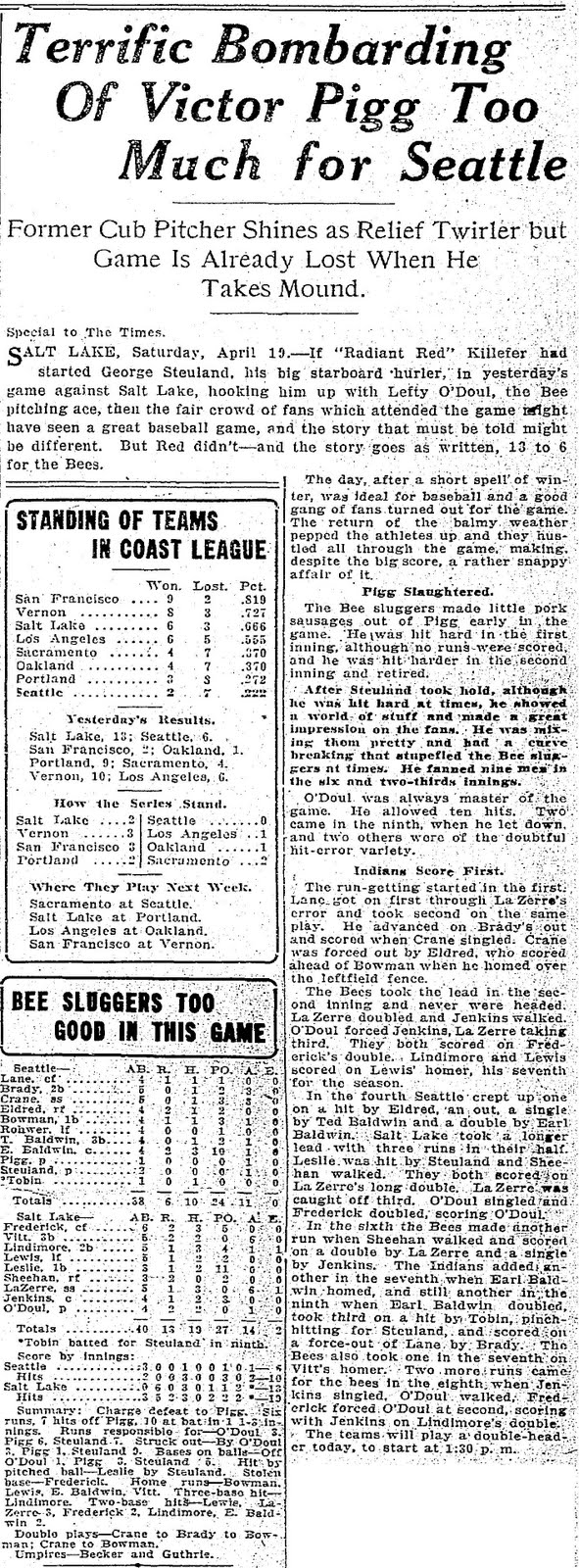
"Pigg Slaughtered". I suppose Victor Pigg never really stood a chance of avoiding that headline. In this game, former Yankees and Red Sox pitcher, and future major league outfielder, Lefty O'Doul was the winning pitcher, with the Pigg performance contributing equilaterally to an evenly dismal start of .222 after nine games. And, being a quality pitcher, O'Doul knew what to do with a 9-4 lead in the fourth inning, so there wasn't much of a reason for anyone else to pitch for SLC. With the number of extra-bases being hit at Bonneville Park, I imagine Duffy Lewis, the Bees Manager, must have appreciated being able to rest his pitching staff once in awhile. O'Doul also contributed with his bat. The Indians and Bees would play two consecutive double headers on Saturday and Sunday. The Saturday game was added due to the rain outs. Sunday was the usual day for a PCL double header.
Another rain delay on Thursday, April 17, 1924
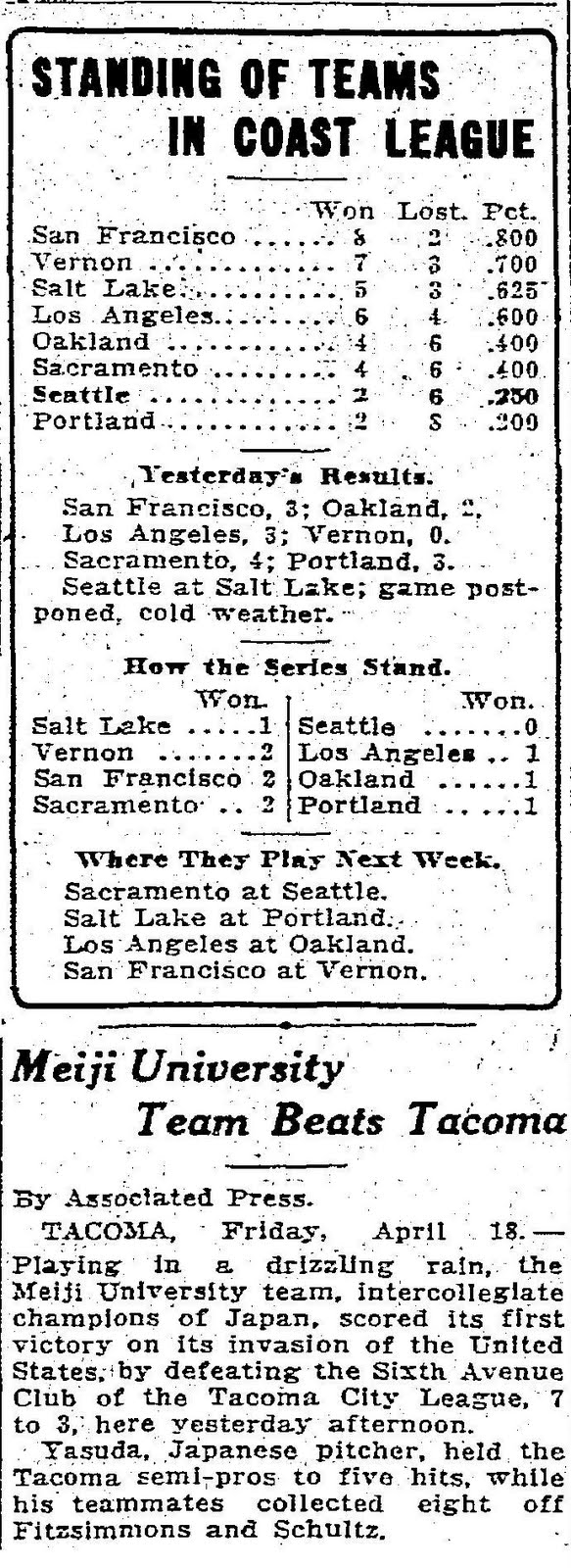
Meiji University continued its tour, beating the Sixth Avenue Club in Tacoma. Meanwhile, the Indians faced the prospect of a second rain out in three days. They would play an extra double header over the weekend to make this up.
Game 8, Wednesday, April 16, 1924
The Indians travelled to Salt Lake City on Monday the 14th, but had a rain/snow out on the 15th. They finally kicked off the series with the Bees at hitter friendly Bonneville Park. Bill Plummer was the loser. One name to take note of is Tony Lazzerri, or as it's spelled in the box score, Lazerre. Another is Lefty O'Doul, who was working his way back to the majors after arm injuries sidelined his pitching career. A lot would happen to Lefty between this game and October 4, 1933, when he would get a single and 2 rbi's in his only career World Series at bat. Lazzeri is in the Hall of Fame, O'Doul is not. He should be. Baseball before WWII was always more than the Major Leagues and the Hall of Fame has recognized that in important ways. They should look at expanding their reach to individuals like O'Doul who do not fit into any tidy category or box. Players and managers who have exceptional contributions outside of the Majors should be recognized. Players who hit .349 for their career should be. I think O'Doul passes the HOF smell test in spite of his short playing career.
The Bees had moved to SLC in 1915, having first seen life as the Sacramento Solons. They would only last two more years in SLC (just long enough for Lazzerri to establish a record for home run excellence with 60) before moving to LA to be the Hollywood Stars, and then to San Diego to become the Padres. Although business was apparently good in 1915, by this game, only 200 fans would attend the early season games.
The box score and column were reported on Thursday, April 17. The following column is from the same day. It details more information about a second rain out that day and how that might affect the pitchers getting stronger for the season. Also, it details some biographical information about Victor Pigg, who would have a four year career in the minors, starting with Seattle and ending in the Western League with Omaha. Follow that link from the Skagit River Journal, which gives details on Pigg's family and life. By 1927-8, Pigg was playing in Bellingham for Northwest baseball legend Tealey Raymond.
The Bees had moved to SLC in 1915, having first seen life as the Sacramento Solons. They would only last two more years in SLC (just long enough for Lazzerri to establish a record for home run excellence with 60) before moving to LA to be the Hollywood Stars, and then to San Diego to become the Padres. Although business was apparently good in 1915, by this game, only 200 fans would attend the early season games.
The box score and column were reported on Thursday, April 17. The following column is from the same day. It details more information about a second rain out that day and how that might affect the pitchers getting stronger for the season. Also, it details some biographical information about Victor Pigg, who would have a four year career in the minors, starting with Seattle and ending in the Western League with Omaha. Follow that link from the Skagit River Journal, which gives details on Pigg's family and life. By 1927-8, Pigg was playing in Bellingham for Northwest baseball legend Tealey Raymond.
Subscribe to:
Posts (Atom)