Seattle's new pitchers for the 1924 Season and the others across the league.
Game 8, Wednesday, April 16, 1924
The Bees had moved to SLC in 1915, having first seen life as the Sacramento Solons. They would only last two more years in SLC (just long enough for Lazzerri to establish a record for home run excellence with 60) before moving to LA to be the Hollywood Stars, and then to San Diego to become the Padres. Although business was apparently good in 1915, by this game, only 200 fans would attend the early season games.
The box score and column were reported on Thursday, April 17. The following column is from the same day. It details more information about a second rain out that day and how that might affect the pitchers getting stronger for the season. Also, it details some biographical information about Victor Pigg, who would have a four year career in the minors, starting with Seattle and ending in the Western League with Omaha. Follow that link from the Skagit River Journal, which gives details on Pigg's family and life. By 1927-8, Pigg was playing in Bellingham for Northwest baseball legend Tealey Raymond.
Game 4, Friday, April 11, 1924
The Seattle Indians picked up their first win of the 1924 season, beating the Angels 9-5 thanks to the hitting of "Henry" known as Ted "Baldy" Baldwin and the pitching of Bill Plummer. I'm sure he'll end up with more nick-names as the season moves along. Plummer, father of a Johnny Bench backup and one-time Mariner manager, had two full seasons of PCL ball in 1924 and 1925, both marred by a consistently sore arm. Otherwise records indicate he played for either Portland in 1921, or Seattle, 1923-27, from the ages of 17 to 25. Apparently, Plummer would marry the sister of Indian teammate Red Baldwin, who would be the uncle of the future Piniella predecessor. Bill Plummer would pitch his last game on August 16, 1927, being pulled in the sixth inning for a tired arm against the San Francisco Seals. 1927 would also be the year Ted Baldwin got his cup of coffee with the Phillies, the highlight of an athletic career that saw him start by playing college baseball at Swarthmore and end up playing baseball for Portland of the New England League. Red Baldwin never got a cup of coffee. His career consisted of spending at least15 years catching in the minors. One of the things I've found when researching old-time players is that they often played semi-pro ball or some type of amateur organized baseball into their 40s. Especially those who were capable of playing in the high minors to major league levels. This often missing history is usually hinted at in small press papers or community records, with notifications of games played at summer festivals or in some local league that lasts maybe a year.
Seattle Game 1, April 8, 1924
In the 1924 Pacific Coast League season, the Seattle Indians and the Los Angeles Angels faced off in a thrilling game at Washington Park. The Indians had just wrapped up their spring training in Los Angeles and were ready to take on the Angels on their home ground. Washington Park, nestled next to Chutes Park on Main Street between Washington and 21st, was a bustling sports venue. It was the home ground for the Angels before they made their move to LA’s Wrigley Field in 1925.
The Seattle Daily Times covered the game in detail in its April 9, 1924 issue. Fans in Seattle had the opportunity to follow the game ‘live’ through an automatic ‘player’ displayed outside the Times’ offices in Seattle’s Times Square, facing 5th Avenue at Stewart.
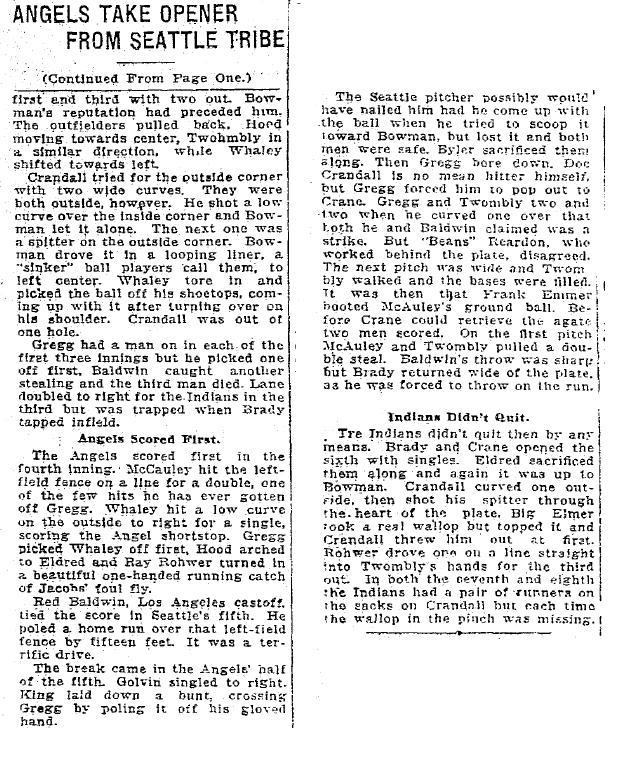
The game was a duel between two seasoned pitchers, Vean Gregg for Seattle and Otis Crandall for Los Angeles. Both pitchers showcased their skills in a beautifully pitched ball game. The Angels emerged victorious with a score of 5 to 1, a victory witnessed by a crowd of 10,364 spectators.
Crandall’s victory came when Gregg’s defense faltered once. Frank Emmer, who was substituting for the injured Ted Baldwin at third base for the Indians, misjudged a hit from Flea McAuley. This allowed two runs to score and set the stage for a double steal that brought in a third run.
Despite this setback, the Seattle team managed to get eleven hits off the Angel veteran, while the Angels got nine off Gregg and Bill Plummer, who relieved the southpaw. Each team had one walk, so honors were virtually even.
The pitchers’ battle was a sight to behold. They appeared to be in midseason form, working the corners of the plate with balls not too good to hit, and mixing their curves, fast ones, and change of pace in pretty shape. They were best in the pinches, easing along when there were no men on bases, and slowing their work when men got on.
Seattle set the stage for a score early when Brady singled sharply to left. However, the Indians didn’t quit after the Angels’ scoring spree. Brady and Crane opened the sixth with singles, but the necessary hit in the pinch was missing. Despite the loss, the game was a testament to the skill and determination of both teams. It was a memorable start to the 1924 Pacific Coast League season.
In the 1924 Pacific Coast League season, the Seattle Indians and the Los Angeles Angels faced off in a thrilling game at Washington Park. The Indians had just wrapped up their spring training in Los Angeles and were ready to take on the Angels on their home ground. Washington Park, nestled next to Chutes Park on Main Street between Washington and 21st, was a bustling sports venue. It was the home ground for the Angels before they made their move to LA’s Wrigley Field in 1925.
The Seattle Daily Times covered the game in detail in its April 9, 1924 issue. Fans in Seattle had the opportunity to follow the game ‘live’ through an automatic ‘player’ displayed outside the Times’ offices in Seattle’s Times Square, facing 5th Avenue at Stewart.
The game was a duel between two seasoned pitchers, Vean Gregg for Seattle and Otis Crandall for Los Angeles. Both pitchers showcased their skills in a beautifully pitched ball game. The Angels emerged victorious with a score of 5 to 1, a victory witnessed by a crowd of 10,364 spectators.
Crandall’s victory came when Gregg’s defense faltered once. Frank Emmer, who was substituting for the injured Ted Baldwin at third base for the Indians, misjudged a hit from Flea McAuley. This allowed two runs to score and set the stage for a double steal that brought in a third run.
Despite this setback, the Seattle team managed to get eleven hits off the Angel veteran, while the Angels got nine off Gregg and Bill Plummer, who relieved the southpaw. Each team had one walk, so honors were virtually even.
The pitchers’ battle was a sight to behold. They appeared to be in midseason form, working the corners of the plate with balls not too good to hit, and mixing their curves, fast ones, and change of pace in pretty shape. They were best in the pinches, easing along when there were no men on bases, and slowing their work when men got on.
Seattle set the stage for a score early when Brady singled sharply to left. However, the Indians didn’t quit after the Angels’ scoring spree. Brady and Crane opened the sixth with singles, but the necessary hit in the pinch was missing. Despite the loss, the game was a testament to the skill and determination of both teams. It was a memorable start to the 1924 Pacific Coast League season.