Game 34, Reported May 14, 1924
Earl Baldwin Features Win With Homer Over Left Field Wall With Bases Full-
Hard Hitting Keeps On."
The Seattle club was moving closer to .500 with a victory over Oakland. the march to the Pennant one day closer. Catcher Earl Baldwin brought the power, and Vean Gregg brought the arm.
Getting ready for the home opener, 1924
One of the more interesting features of this article is its descriptions of the players' reactions to playing at Bonneville Park in Salt Lake City. I've never seen exact dimensions on that stadium as it was in the 1920's, but it's interesting to read into the strategy and frustration players had there. The photo to the left is from the J. G. Preston Experience blog. Judging from the height of the players in the outfield, the left field wall was not only close in, but quite high. Looking at the manager Red Killefer's remarks below, the strategy employed by the hitters makes complete sense. Tony Lazzeri, the first player to hit 60 home runs in a season, must have had some opposite field power to swat the ball over that size of a fence. Ray Rowher and Jim Welsh both homered in the Salt Lake series, Welsh four times, and both were left handed batters. Sam Crane and Earl 'Red' Baldwin each had homer's as right handed batters, and the game narrative indicates Crane's was over the left field wall. Certainly, it seems that the Bees' hitters knew how to use the wall to create doubles. The thing I found most interesting was the large number of putouts by the catchers in every game, rather than the first baseman. There must have been a large area behind home plate which allowed catchers a better chance to catch popups. The catchers for Seattle were credited with 39 putouts for the SLC series out of a possible 150 (that may be off if someone took first on a K, and even with a tag or the occasional out at home, that still means a lot of popups, so why??? I ask....and SLC went to their half of the ninth only 2 of the 6 games, so that's 39 putouts by a catcher in 50 innings [x 3 outs]). That's fully 26% of possible outs made by the catcher.
Finally, the article also mentions the nifty new uniforms given out by team trainer Adolph Schacht. He was Athletic Director at the Seattle Elks Club by 1918, trainer for the Indians, refereed boxing matches for over 20 years in the Seattle area, and was, by at least 1933, also the trainer for the Chicago White Sox, though he maintained a home in West Seattle, and acted as a trainer in the off-season for the West Seattle Athletic Club. Schacht died in January of 1942, just as he was getting ready for the White Sox spring training that year in Pasadena. Follow that last link to read the story, which details some of his experiences in and involvement in Seattle baseball and athletics in general. The article refers to Jumbo Elliott's one year with the Seattle Indians, 1926, where he went 26-20, throwing 367 innings with a 2.55 ERA.
Seattle Game 1, April 8, 1924
In the 1924 Pacific Coast League season, the Seattle Indians and the Los Angeles Angels faced off in a thrilling game at Washington Park. The Indians had just wrapped up their spring training in Los Angeles and were ready to take on the Angels on their home ground. Washington Park, nestled next to Chutes Park on Main Street between Washington and 21st, was a bustling sports venue. It was the home ground for the Angels before they made their move to LA’s Wrigley Field in 1925.
The Seattle Daily Times covered the game in detail in its April 9, 1924 issue. Fans in Seattle had the opportunity to follow the game ‘live’ through an automatic ‘player’ displayed outside the Times’ offices in Seattle’s Times Square, facing 5th Avenue at Stewart.
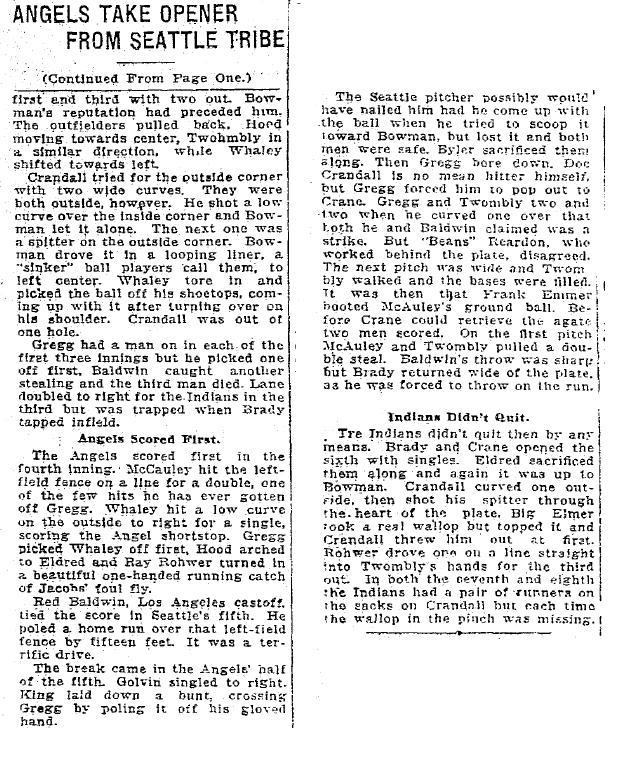
The game was a duel between two seasoned pitchers, Vean Gregg for Seattle and Otis Crandall for Los Angeles. Both pitchers showcased their skills in a beautifully pitched ball game. The Angels emerged victorious with a score of 5 to 1, a victory witnessed by a crowd of 10,364 spectators.
Crandall’s victory came when Gregg’s defense faltered once. Frank Emmer, who was substituting for the injured Ted Baldwin at third base for the Indians, misjudged a hit from Flea McAuley. This allowed two runs to score and set the stage for a double steal that brought in a third run.
Despite this setback, the Seattle team managed to get eleven hits off the Angel veteran, while the Angels got nine off Gregg and Bill Plummer, who relieved the southpaw. Each team had one walk, so honors were virtually even.
The pitchers’ battle was a sight to behold. They appeared to be in midseason form, working the corners of the plate with balls not too good to hit, and mixing their curves, fast ones, and change of pace in pretty shape. They were best in the pinches, easing along when there were no men on bases, and slowing their work when men got on.
Seattle set the stage for a score early when Brady singled sharply to left. However, the Indians didn’t quit after the Angels’ scoring spree. Brady and Crane opened the sixth with singles, but the necessary hit in the pinch was missing. Despite the loss, the game was a testament to the skill and determination of both teams. It was a memorable start to the 1924 Pacific Coast League season.
In the 1924 Pacific Coast League season, the Seattle Indians and the Los Angeles Angels faced off in a thrilling game at Washington Park. The Indians had just wrapped up their spring training in Los Angeles and were ready to take on the Angels on their home ground. Washington Park, nestled next to Chutes Park on Main Street between Washington and 21st, was a bustling sports venue. It was the home ground for the Angels before they made their move to LA’s Wrigley Field in 1925.
The Seattle Daily Times covered the game in detail in its April 9, 1924 issue. Fans in Seattle had the opportunity to follow the game ‘live’ through an automatic ‘player’ displayed outside the Times’ offices in Seattle’s Times Square, facing 5th Avenue at Stewart.
The game was a duel between two seasoned pitchers, Vean Gregg for Seattle and Otis Crandall for Los Angeles. Both pitchers showcased their skills in a beautifully pitched ball game. The Angels emerged victorious with a score of 5 to 1, a victory witnessed by a crowd of 10,364 spectators.
Crandall’s victory came when Gregg’s defense faltered once. Frank Emmer, who was substituting for the injured Ted Baldwin at third base for the Indians, misjudged a hit from Flea McAuley. This allowed two runs to score and set the stage for a double steal that brought in a third run.
Despite this setback, the Seattle team managed to get eleven hits off the Angel veteran, while the Angels got nine off Gregg and Bill Plummer, who relieved the southpaw. Each team had one walk, so honors were virtually even.
The pitchers’ battle was a sight to behold. They appeared to be in midseason form, working the corners of the plate with balls not too good to hit, and mixing their curves, fast ones, and change of pace in pretty shape. They were best in the pinches, easing along when there were no men on bases, and slowing their work when men got on.
Seattle set the stage for a score early when Brady singled sharply to left. However, the Indians didn’t quit after the Angels’ scoring spree. Brady and Crane opened the sixth with singles, but the necessary hit in the pinch was missing. Despite the loss, the game was a testament to the skill and determination of both teams. It was a memorable start to the 1924 Pacific Coast League season.