Game 20, Monday, April 28, 1924


The photograph above is from a Tuesday, April 29, 1924 edition of the Seattle Daily Times. I’m not sure which edition, probably an early one since it details the previous day’s games. They had a new ‘long-range’ camera that year they had nicknamed Aunt Eppie. I’m pretty sure that has to do with the size of the camera. Aunt Eppie was also a recurring character in the Toonerville strips which appeared on the sports pages of the time. Could also be from some other cultural source, but I am not well read enough to know that..yet. The photo above is from the Monday, April 28, game between the Seattle Indians and visiting Sacramento Senators. This game was the final one is their 7 game weeklong series. In the PCL of the time, teams played each other each week for a weeklong series, and often used Monday as the travel day between series. In this instance, the game was played on the Monday since Sacramento only had to travel to Portland for its next series. The Indians’ next opponent was the Salt Lake City Bees, who would be coming up from Portland.

Here is the caption for the exciting photo essay: “Aunt Eppie disagreed with the Seattle fans and the Sacramento players in yesterday’s game between the Indians and the Solons. Her first effort (Photograph No. 2) shows that Billy Lane was out at second in the first inning when he tried to steal after a pitch out had spoiled Sammy Crane’s chance at the hit and run. McGinnis is putting the ball on Lane, who is still two feet from the base. Her second effort (No. 3) shows that McNeeley ran out of the base line to avoid being touched by Elmer Bowman, whereupon Umpire Carroll called him out, much to the disgust of the Sacramento players. 1-Earl McNeeley, star of the Solon attack and defense in the series which closed yesterday. 4-M. H. Sexton, head of the minor baseball leagues, who will be a Seattle visitor Friday, Saturday and Sunday.”  I’ve cropped the picture of Sexton and put it off to the side. For more about Sexton and his history with the game, read here.


Canfield Tames Ambitious Indians
Tribe Wastes Its Hits and Loses 4 to 1
Steuland’s Wildness Has Him in Trouble-Seattle Has Men on Bases in Every Inning Off Southpaw.

THE Seattle tribe lost a baseball game yesterday 4 to 1, the left-handed shoots of young Mr. Carroll Canfield of Sacramento taming them effectively in the well known pinches. Canfield allowed eleven hits, walked two men and his mates made a pair of boots behind him, yet he emerged with only one run scored off him in nine innings.

The small Monday crowd was kept constantly in hot water by the display of the Indians. Every minute it thought runs were going to come trooping across the platter in droves, but in every minute but one it got fooled.
Opposed to Canfield was George Steuland, coming back after having pitched on Friday. George was wild-not so awfully wild, to be sure, but just wild enough to give a smart team like the Senators plenty of opportunities. His big curve was missing the corners by inches and the Solons, up there letting everything go by until they absolutely had to hit, worked him for six bases on balls in as many innings.

Steuland is Cool.

In spite of his trouble with his control Steuland looked exceptionally good on the mound. He is as cool as a cucumber in the pinches, has every faith in his own aility to pull out of holes with ordinary support, and did pull out of several such predicaments by some nice work.
Kopp scored the first run on him when he poked the ball into left field for a single with the count of three and one on him. He stole second. Crane held him there while he threw out Hemingway, but Siglin doubled to left on a three and two count scoring the fleet “Koppie”.
Two walks to Hemingway and Siglin in the fifth were wiped out with a speedy double play, Ted Baldwin to Brady to Bowman, but in the sixth another base on balls, to Cochrane, paved the way for a pair of runs. Mollwitz sacrificed and McNeeley dropped a Texas League double on the right field foul line for a run. McGinnis poked another Texas leaguer over second and McNeeley, setting sail for the plate, scored when Billy Lane was unable to hold the catch, made at his shoe tops and at full speed.
The last Solon run came on a good clean shot across second by Shea, Cochrane’s force of him, Mollwitz’s sharp single, and a ball that took a bad bound off Ted Baldwin’s shoulder, and McNeeley’s sacrifice fly to Rohwer.

McNeeley Has Big Week

This lad McNeeley, by the way, had a wonderful week here.
In seven games he scored ten runs on twelve hits, for an average of .444.
He handled 25 chances in center field, eight in Sunday’s second game and five more yesterday.
He looks like the best bet in Sacramento’s outfield.

Indians Waste Hits

While the Solons were making the most out of the little they drew, the Indians, with Mr. Canfield acting as the chief drawback to their ambitions, were wasting aplenty. They had men on base in every inning, yet were able to push a man over that last rubber platter but once in the nine.
The Solons outsmarted them right off the bat after Billy Lane had opened with a single. A pitch-out with Crane at bat caused Lane to be nipped stealing, and with a poor throw at that. Billy started his slide too soon and didn’t quite make the bag.
Incidentally, it was the first time all week that Cliff Brady had failed to sacrifice, two fouls forcing him to hit, whereupon he flied out.
Crane followed with a single to left, stole second, but died there when Brick Eldred grounded out.
Brick, the chief of the Sand Blowers, finished an unbroken run of hitless times at bat of ten with yesterday’s game.
Bowman opened the second with a beaten-out bund, much to the surprise of the natives, who have figured him slow. It was perfectly placed. Rohwer forced him, then was picked off stealing, following which Ed Hemingway kicked Ted Baldwin’s ground ball. Earl Baldwin forced him.
Canfield got the first two men up in the next two innings, so that Brady’s single in the third and a walk and a beautifully executed hit and run play by Ted Baldwin on the hitting end and Ray Rohwer on the running end were wasted when Crane and Earl Baldwin couldn’t deliver.
Lane and Brady singled together in the fifth, but Crane and Eldred failed.
Rohwer walked again with one out in the sixth, but the Baldwins flew out.
The one Indian run came in the seventh, when Lane and Brady again singled together, Lane taking third on Hemingway’s high throw. Crane’s sacrifice fly scored Lane.
Bowman singled to open the eighth, but a signal “ball up” caused him to go out stealing.
Grimly the Indians held on and staged a young rally in the ninth. Earl Baldwin singled to start things. George Cutshaw, who had won Sunday’s first game with a pinch blow, batted for Steuland and walked. Emmer and Jimmy Welsh, both fleet of foot, were put in to run for the pair, but Lane and Brady had run out of hits by this time and Same Crane popped to Mollwitz.

Brucker Sees Game

Earl Brucker, rookie catcher, hurt in Sunday’s second game, watched the game from the grandstand.
Dr. A. Rocke Robertson, who had attended him, released him from the hospital at noon yesterday, supposing he’d go to his hotel and stay.
Brucker would probably have asked for a uniform if he hadn’t been met with the reception he was. He still a bit dizzy, but expects to be in a suit again perhaps today or tomorrow.

Two Pitchers Hurt.

Two Indian pitchers, Bill Plummer and Harvey (“Suds”) Sutherland, are on the hospital list yet, though Sutherland may be able to work this afternoon. Plummer’s arm is bound up with an injured tendon in the elbow, while Sutherland has been bothered with an ankle injured rounding first base in the opening game.
Steuland came back after only two days of rest for the game yesterday, but he is strong enough to carry considerable work, and will probably get it. Vean Gregg and Wheezer Dell will probably start early games against the Salt Lake Bees, who arrived here this morning to start a seven game series this afternoon.

Games 18 and 19, Sunday, April 27, 1924

Because of the short travel distance from Seattle to Portland, Seattle was able to schedule their home opening series against the Sacramento Solons from Wednesday to Monday. Opening Day had featured a long parade that wound through downtown Seattle before heading over to Rainier Avenue South and the Coast League Park. I am going to try to rebuild the attendance numbers, because it seems as if Seattle was really drawing good crowds. Although they played a large number of double headers, attendance seems to fluctuate between 5,000 and 8,000 fans on weekdays, and upwards of 10,000 on weekends. I found a Sporting News article from the summer of that year exclaiming an attendance of 51,000 for 3 weekend games.

My point is, the PCL had clubs like Seattle that drew on par with some MLB clubs. It speaks to the quality of baseball being played as much as the popularity. In Lyle Kenai Wilson’s Sunday Afternoons at Garfield Park, he quotes an article from 1911 I believe, that states attendance for a game between a Nisei club team and a Negro League club that drew 4,000 fans at Seattle’s Woodland Park. Now, the two details I find most interesting about that are the place and the population. The place, Woodland Park, which at that time of electric trains and somewhat segregated neighborhoods in the city, meant the 4,000 people coming through the gate were a mix of Nisei, Issei, and African-American, as well as the locals who lived around the Woodland Park neighborhood, which is lots of Scandinavians at that time. Now, the other part is the sheer number of 4,000. I remember going to Mariner games in the Kingdome in the early 80’s with fewer fans. We see this in 1924 as well. In another post on the Meiji University baseball team tour of that year, one of the biggest contests for that team was plying the Nippon AC baseball club. That game took place at the Coast League Park instead of a smaller venue. Crappy baseball, even if it’s part of a major cultural event, doesn’t draw a crowd. If you're getting 4,000 people, your playing good. I think if you look at the makeup of the teams in the semi-pro and city leagues, you gain an important insight into the demographic makeup of a place and the way those populations interact, more so than the big club. The semi-pro leagues were always integrated, that's part of baseball history going back to the time of proto-ball before the Civil War. The melting pot was often a chunky soup. Baseball, as a source of information, can thus tell us about race and society. I mean, after all, this team I’m writing about is called the “Indians”. That means something deeper than itself.

On Sunday, April 27, 1924, a Seattle crowd reported at 12,000 got to witness a double header filled with excitement and dismay across an 18-inning afternoon. Certainly, fans got to see both sides of a team that would go from worst to first, though on this day they saw the best first, and worst last.

By the end of that Sunday slate of games Seattle was still one spot out of the basement, but you could definitely see the makings of a contender.
Standings of Teams in Coast League, as of Sunday April 27th:

Team                                       Won    Lost     Pct.
San Francisco                          13       8        .619
Vernon                                    13        8        .619
Salt Lake                                11        9        .550
Los Angeles                            11       10       .524
Oakland                                  10      11        .476
Portland                                   9       12        .429
Seattle                                      8       11       .421
Sacramento                              7       13       .350

Sacramento and Seattle would have more game to play on Monday before the start of the fourth week of the season. On this Sunday, they split the fifth and sixth games of their series. Seattle won its fifth straight in the early game 3 to 2. Sacramento finally picked up a game by winning the late game 15 to 5.
Ray Rohwer, maybe the last great left fielder ever to play professional baseball in Seattle (perhaps his trade at the end of the season could be looked as Seattle’s own lost and unknown, and position-specific Curse of the Bambino), had his consecutive plate appearances reaching first base streak snapped at 13. I found the hitting stats published in newspapers for the 1924 PCL season. They came out in December. It tracks games, at-bats, runs, hits, stolen bases, home runs, triples, doubles, sacrifice hits, runs batted in, caught stealing and batting average. As we have seen from looking through the narratives from the dailies and looking into the box score, guys like Rohwer must have had a significant on-base percentage. I will be trying to rebuild those types of statistics as this project moves along.
The staff writer highlights the pinch-hitting ability of George Cutshaw, showing his reputation to be, as the term would come later when cars became more ubiquitous, a clutch-hitter. Although, and maybe this is because the writers were stationary, I’m not sure when they started traveling with the teams, Cutshaw had actually had a pinch-hit at-bat in the fifth game of the Salt Lake series, going 0-1 in what was apparently a forgettable 15 to 10 loss on Sunday, April 20. Although, perhaps by “yesterday’s opportunity to hit, his first” was meant to indicate his first hit rather than simply his first at-bat. Cutshaw would get 53 at-bats in 43 games that year, with his average declining from its current .500 down to .245. Truly, his wisdom would have more teeth than his batting.
Although, just this one win would make a difference at the end of a 200-game season.

On a sadder note, catcher Earl Brucker suffered an injury when Earl McNeeley, who would end the season with a heroic moment in the 1924 World Series, swung his bat all the way around as Brucker dived forward. The bat hit Brucker on the head, behind the left ear. I don’t know what happened to Brucker after that. We’ll see, but the promising young catcher would eventually make his way to the majors in 1936. Eventually, he would even get to manage on an interim basis for the Reds. I am not sure if this injury contributed to his delayed shot at the top, but his record in Baseball Reference is sporadic for several years. He played in 1925 and 1926 for Lincoln in the Western League, then nothing for the next four years. Then, in 1930, he starts making his way back up through the minors. It may be that these injuries contributed to his difficult in playing, or that he played semi-pro ball. Probably he worked for a living to support a young son.  But, eventually he would land that spot on a major league roster. I’m sure after his struggles, under the presumption he struggled, that must have been quite a day. I will look around, see if I can find evidence of him playing semi-pro ball.I do know that he and his son, Earl Brucker, Jr., eventually ran a race track in El Cajon. Brucker, Sr. was also a legendary high school player in San Diego.

Another story developing that year was how the pitching staff had come together. I read an article in a recent Baseball Research Journal about the development of the five-man pitching rotation. Here is a picture with a little blurb about the development of Seattle’s starting pitching staff that year. 1 is Bill Plummer, the youngest Seattle pitcher that year and about whom I’ve written before. He would eventually marry the sister of one of his teammates and have a son in the 1940s. That boy, also called Bill, would later back up Johnny Bench and have a disastrous season as a manager of the Seattle Mariners. 2 is Suds Sutherland, who was obtained in a trade for Harry Gardner, a pitcher that had been obtained as part of the same acquisition in December 1922 that brought Ray Rohwer to Seattle. 3 is George Steuland, late of the Chicago Cubs in an off-season acquisition, and previously managed by Wade Killefer’s brother Bill for that venerable franchise. 4 is Jim Bagby, just 4 short years removed an historic season and World Series with Cleveland’s 1920 champions. I don’t know if anyone has written a book about the 1920 Cleveland team, but it should happen (Bagby's son, Jim Bagby, Jr., also has a place in baseball history). 5 is Vean Gregg, who had been the best pitcher in the PCL in 1923, resuscitating a career once thought lost to arm injury. Gregg was one of the top pitchers of the early 1910s, and although he would get one final shot at the majors, this year was giving him his real final shot at glory.
Wade Killefer used his pitchers both in relief and as starters, juggling them around to meet the needs of the 7-game work week that saw usually between 54 to 70 innings of pitching needed. For instance, although Gregg was a veteran and the best pitcher in the PCL probably, so far in 1924 he had been used in relief as well as starting. Other pitchers on the staff were Wheezer Dell, who had been obtained from Vernon on waivers in 1923, Texan Carl Williams, local boy made good Vic Pigg, and Percy Lee Jones. Wheezer Dell and George Cutshaw were teammates on the 1916 Brooklyn Robins team that made the World Series.


As Reported in the Seattle Daily Times, Monday, April 28, 1924:

Win Clever Victory In First But Show Terribly in Second
Rohwer Stopped by Southpaw Thompson-Charlie Hall Beats Seattle With Well-Pitched Game.

THE Seattle team’s winning streak was stopped after its fifth victory over Sacramento yesterday and a banner Sunday crowd went home sorely disappointed at the showing of their athletes. The Indians won the first game 3 to 2 after apparently being beaten again, then turned around and got all the bad baseball possible out of their systems in the second, which they lost 13 to 5.
            More 12,000 people, a bigger crowd than opening day, attended the games, cheering the showing of the Indians in the first encounter, but showing considerable disgust in the second. Large numbers of the crowd left in the late innings of the second game.
            Ray Rohwer, Seattle left fielder, who had gone thirteen consecutive times at bat, making seven hits and drawing six bases on balls in that time, was stopped by the left-handed shoots of Thompson, the Sacramento pitcher in the first game, but came back with two singles off  Charlie Hall n the second encounter.
            The first game goes down in the books to the winning credit of Vean Gregg for it is pitchers who get credit for wins and losses, but to George Cutshaw, veteran of 15 years of baseball, goes credit for the winning runs.
            George went to bat in the pinch in the seventh inning with Indian runners roosting on second and third and Sacramento leading, 2 to 0. He delivered a healthy single to left, on the second ball pitched to him, scoring the pair and sewing up the game. A boot by Catcher Shea of the Solons let the winning run come across an inning later.
            When Cutshaw was with Brooklyn in the National League he was noted for just those stunts. He went along for nearly ten years, never a lusty hitter, but oh, such a bad actor in the pinches. Let the Superbas be a run or two behind, let a runner or two be on base waiting to score, and it was George Cutshaw’s time to act.
            It was with that in mind, because he needed a sound head out on the coaching lines with him and because if Cliff Brady was hurt there was no one left to take his place that Wade Killefer signed Cutshaw this spring. His coaching has been high- lass right along and yesterday’s opportunity to hit, his first, shows that he may be mighty valuable before the year is over.

First Game Well Played
            The first game was a splendidly played contest and the big crowd was in great humor when it was over.
            Sergeant Jim Bagby started for Seattle, with Lefty Thompson opposing him. For four innings they battled without a run being scored.
            Bagby looked fine. His control was splendid and the Solons didn’t hit a ball hard off of him all the time he was on the mound. Thompson, too, had everything for six innings, but when he broke he went sky high.
            McNeeley beat out a hit to deep short to open the fifth inning for Sacramento. McGinnis poked one at Elmer Bowman and in swinging hurriedly to make a force play at second Bowman threw high and wide. Crane made a great leaping catch but both runners were safe. Thompson sacrificed them along.
            Merlin Kopp, who had driven in a flock of Sacramento runs Saturday, dropped a lazy fly squarely on the right field foul line, scoring the two runners. Bagby came right back and stopped the Solons in the sixth and seventh, and then the Indians got busy.
            Elmer Bowman started the rally with a drive to left. Ray Rohwer forced him and Ted Baldwin followed with a double to left center on which Rohwer took third.
            Here it was that Manager Killefer called Cutshaw in to bat for Frank Tobin. Cutshaw looked over a bad ball, then hit a curve ball on the inside corner sharply to left, scoring the pair.
            The Indians won the game in the eighth on a single by Billy Lane, a base on balls to Brady, a sacrifice by Crane, an intentional pas issued to Brick Eldred and Bowman’s tap to third. Hemmingway fielded it cleanly, forced Lane at the plate but Catcher Shea in attempting to double Bowman at first threw into right field, Brady scoring the winning run.
           
Second Was Dismal
            The second game was as dismal as the first was thrilling. Everything imaginable in the way of bad baseball was inserted into the program by the Indians.
            Percy Lee Jones started to pitch, was wild as a hawk and after two runs had been chalked up and he had the bases full in the third with no one out Vic Pigg took up the pitching.
            Pigg caused Mollwitz and McNeeley to force men at the plate. It looked for a moment like he was going to pull the Indians out of that hole. But “Cooey” McGinnis, the midget shortstop of the Solons, dropped a long fly between Lane and Eldred for two bases, scoring Smith, Mollwitz and McNeeley.
            From that time on things got worse instead of better. Pigg was both wild and ineffective, the Solons scoring in every inning except the seventh and ninth.

Newcomers Get Chance
            Manager Wade Killefer sent Catcher Brucker, Shortstop Frank Emmer, First Basemen Jimmy Walsh and Outfielder Frank Osborne into the game, after the fifth inning.
            Osborne performed the unusual stunt of driving two balls over the right field fence, both foul, however, and then doubled to right in his first trial. Jimmy Walsh followed with another double to the same field, but Osborne thought the ball was going to be caught and was held at third on the hit.
            Emmer and Osborne both figured in a belated Seattle rally in the ninth that netted three runs.
            The Sacramento team plays here this afternoon following which Salt Lake City opens a seven-game series tomorrow afternoon.

Game 17, Saturday, April 26, 1924


The first week of the season, the Seattle Indians' bats were just awful enough for last place. For whatever reason, reasons probably having more to do with the Angels pitchers starting strong than anything else, it took a train ride to the still-in-winter confines of Bonneville Park in Salt Lake City before Seattle started finding the ball with any consistency. Wade Killefer stated during spring training he thought the Indians would have a good hitting team that year. That is what started to emerge during the second week of the season.

Spring training began for pitchers and catchers in the hot springs at Elsinore on March 2, 1924, followed by all players reporting on March 9 in lovely San Bernardino where they headquartered at the classic Stewart Hotel. The team left Riverside County just before the start of the season to stay in Los Angeles and complete spring training.

The results of the first two weeks was a 3 and 10 record at the hands of good pitching in LA and good hitting in SLC.
The Salt Lake Bees were a club that would feature the two best hitters in the Pacific Coast League that year, Duffy Lewis and Lefty O’Doul, anchoring a lineup that would lead the PCL in batting at .327,  and that power proved to be the dominant factor in that series.  But, against Sacramento, Seattle started to finally put it all together.

The Seattle bats were finally waking up for good on the train ride home to Seattle’s Coast League Park, as Dugdale Field was referred to in many of the news reports of the 1924 season. When the players had converged in San Bernardino for Spring Training, they left off-season homes in such places as Texas, Missouri, and the Bay Area. After a little over a month, they had moved spring training to Los Angeles before starting the season against the Angels. Then, finally, after a week in Salt Lake in late April, they were in what for many was a home away from home, the Rainier Valley of Seattle.

Ray Rohwer continued to be an on-base machine, now having reached first base in 13 consecutive trips to the plate. He hit a home run, a triple, and put across 2 RBI’s in this game, a remarkable display of power for a hitter who had walked in 4 straight trips to the plate the previous day. Ray Rohwer had gone straight to the Pittsburgh Pirates from the University of California, although his playing time had been interrupted by service in World War 1. I’m not sure how, still need to investigate, he was allowed to play for California in the 1920 season in spite of the fact he graduated in 1917. Rohwer hooked up with Pittsburgh in 1921 as a 26-year old rookieRohwer had gone to spring training in Texas for the Pittsburgh Pirates with his brother Claude, after both finished playing for the University of California. Ray was able to stick with Pirates for 1922 after showing some promise in spotty appearances in 1922. The after-the-fact highlight for Rohwer, and baseball history, was his go-ahead RBI single in the first ever baseball game broadcast on radio, on August 5, 1921. Rohwer came in to hit for first baseman Charlie Grimm, and lined a single, and also added a run to seal the deal. Unfortunately, he added an error in right field in the top of the ninth, but the Pirates still won 8-5 over the Phillies. The first game was actually a re-broadcast of sorts. It was on KDKA, the pioneering radio station in Pittsburgh, Pennsylvania. The game was called by KDKA’s regular announcer, Harold Arlin.

Ray Rohwer could always hit, unfortunately for him, he was trying to break into the best hitting club in the National League in 1922 (the regular top four outfielders for Pittsburgh collectively batted .342 that year, with Max Carey’s .329 being the worst!). Left-handed hitting Rohwer was mostly used as a late-inning pinch hitter against right handed pitchers, but did get 28 starts among his 53 games that year. Although he finished 1922 with a .295 batting average (one of 11 Pittsburgh position players to hit at least .290), on July 1, following a double header, Ray was hitting .386 with a .446 on-base percentage and a .627 slugging percentage for an overall OPS of 1.072.  Over a four game stretch he went 12 for 19. However, a slump followed, and on July 21, Rohwer lost any shot of getting the right field spot when left-handed hitting Reb Russell showed up from the Minneapolis Millers, completing a remarkable return to the majors for the former White Sox pitcher who had injured his arm in 1919. Russell came back from that injury as a power hitting outfielder, joining Carson Bigbee and Hall of Famer Max Carey in creating a formidable outfield for Pittsburgh. Clyde Barnhart also filled out the fourth outfielder spot, making Rohwer more valuable as a trading commodity than a fifth outfielder, especially since he was probably a 27-year old, what you see is what you get who wanted to get back out west. Rohwer was traded to Seattle on December 6, 1922, along with the first pitcher  in Seattle to be called “Sherriff”, John Fred Blake, cash and a player to be named later for infielder Spencer Adams. Adams was considered a prized prospect, but would spend most of his career going from one team to the next, not spending consecutive years in any location until he was 31, at Nashville in the Southern Association. Rohwer was considered a good hitter, but the Seattle Daily Times article on the trade wondered if his fielding would be good enough to make it in the PCL.

Claude had been invited to Spring Training to possibly be the Pirates answer for third base. But in spring training 1922 they decided to give that shot to a young prospect they had paid $10,000 for, although he had projected to be a second baseman or shortstop. The young prospect, Pie Traynor, could hit, but his defense was suspect, and they still had Rabbit Maranville, a great and mercurial personality, if not shortstop, already. So, on the opening day of the 1922 season, Ray Rohwer found himself starting the bottom half of a double header against Cincinnati, only to be pulled before getting an at-bat, Claude Rohwer was playing shortstop for the Charleston Pals of the South Atlantic League, and at third base for Pittsburgh was the young prospect Claude lost out to, Pie Traynor. Traynor would go on to have a Hall of Fame career and generally be viewed as the National League’s premier third baseman between the Deadball era and World War II. Claude had a short career in the PCL, playing third base for Sacramento along with Ed Hemingway. My blind hope/curiosity suggests that Hemingway might be a second cousin or so of the other E. Hemingway. They are about the same age. I think at this time, Spring of 1924, Ernest is probably off in Paris or Pamplona preparing to be important. Claude would return, like the other Rohwer brother, to Dixon.

Meanwhile back in Seattle on a Saturday afternoon, across the board the hot hitting continued, and in an excellent sense of foreshadowing, the Indians pulled it out in the late innings. The pitcher on this day for the Senators was, like Rohwer, a former member of the Pittsburgh Pirates named Moses Yellowhorse.

It’s a curious thing to think about: why do some of us love a game so much? We dedicate hours, days, lives to the minutia and incidentals of some far away or at best parallel universe. Often times, as sports fans of an intellectual bent, we cannot even display great insight to our own form of play, this interaction with distance. Certainly some of this has to due with the element of play in the human psyche. Boyish, or girlish, or just adolescent, acts of self-definition. Some theories of art look at the impact of peak shift experiences on the individual exploring the plastic work. That is, what is it about a static object that incites engaged participation? I think that type of approach explains, also, the ‘art’ of baseball, or any sport. Many players, observers, reporters and critics have noted the theater of sport. Going back to the Roman Circus or Greek Olympics, sport was often lumped in with the various cultural activities of a celebratory nature. This was also true across America. We can attribute that somewhat to the post-Renaissance influence of classical societies, but I think this is more an accurate description of human tendency, rather than a fixed operation of particular origin. In short, the harvest festivals had sporting contests at their center, or at least near the center. In most circumstances it was a safer version of the hunt, or a more public exhibition of thrashing. And there was baseball. Baseball, as it grew into its oversized jacket as the American Pastime and then into the pastoral landscape of fogged collective memory, was nearly always a part of the community and its rejoinders of atonement, a process which in the industrial and advertised landscape that was always becoming, the Twentieth Century, became the moments in the days just past the harvest, where we  find and fix the happenstance participants of a given time to a given space, that is to say we create myth’s from the substance as much as the essence of reality. Much like we remember where we last hunted a deer or the angle of the sun when the berries ripened, it is the forthcoming winter absence that seeks to gather collectively before we sink into the winter hive, and this festival, this gathering, is where we remember the significant moment of play, the winning comeback in the bottom of the eighth.  Thus, an essential component of our fanaticism is the way in which it allows us to passively experience our hunter/gatherer past through both a satisfaction of the curiosity impulse implicit in the hunt, and the peak shift experience essential to the kill.

Another element essential to the development of fanaticism, one that runs parallel and is part and parcel of the fan, is the dual role in which re-imagination plays along with the experience factor: the apprehension of identity, or identifying with the players. The key there is what part of our identity the players, managers, or game itself, the game experience, with which we identify. Which brings us to Moses Yellowhorse and Ed Delahanty, two players connected for the purposes of this argument solely through the manner in which I identified with them at a certain age of my own life. Ed Delahanty was the first baseball player whose story I found inexorably fascinating. I was in middle school, in Olympia, and had run across his story in a book about the 50 greatest players of all time. For some reason, the irascible drunk who disappears after getting thrown off a train and trying to cross a trestle at Buffalo at night spoke to me. There was something in that irrational act, that lack of ending, with which I connected. The same with Yellowhorse. Much like the author of the book The (Baseball) Life of Moses Yellowhorse, Todd Fuller, I simply saw the name Yellowhorse and immediately recognized someone as probably being a fellow American with Native heritage. But, the story is much richer than that, because this is 1922, and Moses Yellowhorse was the first full-blooded Native American to play Major League Baseball. In 1922, its not really heritage as I see it, its life as a Pawnee, being lived. The world was not historical, but rather one of sharing experiences with those who are not part of the pastoral past, a world that ran fully against that notion and had to be brought into it through conflict; a world not populated with characters, but people with wounds, pride, and a child who could probably hunt by simply hurling a rock at a bird. He grew up on, and would return to, the Pawnee reservation, and went to school, and played baseball for, the Chilocco Indian Agricultural School. Yellowhorse came under the wing of former Yankee (Highlander) interim manager/player Kid Elberfeld, who by 1920 was in his mid-40s and managing the Little Rock Travelers of the Southern Association. Moses’ blazing fastball would get him to Pittsburgh in 1921, and he’d pitch 126 innings before an injury and alcohol would relegate him to the minors. His drinking partner was his roommate, the previously mentioned Rabbit Maranville. Moses would eventually kick the booze in 1945 and become a leader in his community.

In this 1924 game, Yellowhorse’s career is coming near its end as far as professional ball would go. He would only appear in 10 games that year, then two more in 1926 for Omaha. I highly recommend Todd Fuller’s book on Moses Yellowhorse. It uses poetry, prose, personal narrative, history and biography to tell this unique man’s unique story.


8,000 Seattle Fans See Tribe Rally And Beat Solons, 7 to 6
Going Into Eighth Inning Four Runs Behind, Local Team Chases Yellowhorse From Game With Fierce Attack.

REFUSING to be beaten even though the Sacramento team had them 6 to 2 when they went to bat in the eighth inning, the Seattle team staged a great rally in its half, drove in five runs with six terrific hits, a hit batsman and a base on balls, defeated Sacramento 7 to 6 and won its fourth straight home victory over the Solons.
            A crowd estimated at 8,000, one of the largest Saturday crowds in the history of Seattle baseball, saw the thrilling rally.
            Ted Baldwin’s home run over the right garden wall with Ray Rohwer on first base put the finishing touch to Mose Yellowhorse, chased him from the game with a tie score. Whereupon Lefty Vince came on, hit Tobin, walked Carl Williams and was hit for the winning single by Billy Lane.
           
Ray Rohwer, Seattle left fielder, contributed a triple, a home run and a single in his last three times at bat, and was given a base on balls in his first trip to the plate.
            He has now stepped to the plate thirteen consecutive times and reached first base on every attempt.
            Four hits, two of them triples, and a base on balls Thursday-
            Four consecutive bases on balls Friday-
            A base on balls and three consecutive hits Saturday-
            That is Rohwer’s record.

Figured Game Lost
            The 8,000 fans on hand figured the game gone when the Solons landed on Wheezer Dell in the sixth and seventh for five runs, which, with the one they had scored in the fourth, game them a five-run lead.
            But Ray Rohwer boosted one over the fence to start the seventh. He had already scored a run in the fith when he hit the center field fence for three bases and rolled in on Ted Baldwin’s double.
            Yellowhorse got them out in the seventh without further damage, but the eighth was-oh, so different.
            Cliff Brady started the fight by singling to left.
            Sammy Crane, who had already hit safely twice, doubled to left center.
            Brick Eldred singled sharply to right, Brady scoring.
            Elmer Bowman hit one hard right at Hemingway, however, and was doubled up with Eldred.
            Two out, three runs to go to tie. It didn’t look exactly encouraging.
            Ray Rohwer came up to try and do something for his thirteenth straight trip to first. He singled to right and Crane came over.
            Ted Baldwin got hold of a fast one on the outside corner and over the right field fence it went. The score was tied.
            Mose Yellowhorse left the pitching mound in bad order and Lefty Vinci came in.
            Lefty hit Tobin in the leg. Then he walked Carl Williams.
            Sensing that break Wade Killefer sent speedy Jimmy Welsh in to run for Tobin.
            Billy Lane, with three and two on him, and the runners under way, singled across second, scoring Welsh and putting Williams on third.
            Vinci also departed and Lefty Canfield retired the side with the Indians one run to the good.
            Carl Williams blanked the Solons in their half of the ninth and the fourth straight was on the winning side of the ledger.

One Hit, All Hit.
            It was the same story yesterday as it has been all week.
            When one Indian hits they’re e all liable to start right after him.
            Yesterday they wasted four hits, more than they had wasted all week, but it took some great playing  to stop them as long as Yellowhorse did.
            For instance, the Tribe was off on one of its rallies in the fifth. Rohwer opened with that long triple and scored when Ted Baldwin doubled over McNeeley’s head. Frank Tobin, who had received a big bunch of carnations from the Seattle local of the plumbers union, “Big Tob” being a member of the Sacramento local, hit one squarely on the nose to right field. Siglin made a marvelous stop and throw to first to nail him. Billy Lane followed with an equally hard-hit ball to left field that Merlin Kopp made a great catch on. Hemingway and Mollwitz had turned in some fine plays before that, too.
           
Dell Starts Well.
            Wheezer Dell started as though he would need only one run to win.
            For three innings he mowed the Solons down without a hit. Frank Tobin helped him out of his few difficulties with some great throwing. He stopped Hemingway stealing in the first and nipped McNeeley off of first in the third with a snap throw.
            Kopp’s double, a sacrifice and Schang’s single broke the ice and put the Solons ahead in the fourth, the first time all week that they had been in the lead.
            Dell had two out in the sixth before trouble overtook him. Hemingway singled and Siglin and Schange doubled for a pair of Solon tallies.
            Three more came over in the seventh inning and caused Dell’s retirement in favor of Greg.
            Crane booted a slow hopper from Mollwitz’s bat, and then was caught out of position on a hit-and-run play when McNeeley pushed a lazy single through short. Cooey McGinnis tripled to the left-field fence, scoring the pair and counted himself on Yellowhorse’s long fly to Lane.
            Gregg came on, put out the side and retired in favor of “Papa” Frank Osborne, who tried to celebrate the arrival of a nine pound boy in his St. Joseph, Mo., home by pinch-hitting. McNeeley made a fine catch of his long line drive.
            Then came Carl Williams, with the score tied, and the Solons were stopped dead and Texas Carl gets the credit for the win.

Some things

I'm still working on the post for the next game. My router was broken. Here's a few diversions. Click on each picture to be taken to a link to a particular story.

Game 16, Friday, April 24, 1924

On Friday, April 25, 1924, the Seattle PCL ball club played the 16th overall game in what was their third series of the year. In the PCL of the time, a given series between teams lasted Tuesday/Wednesday to Sunday/Monday, so this was also the third week of the season. Generally, there were 7 games to a series, minus rain-outs, train delays, etc.

The Indians made it three straight against the Sacramento Senators, winning by a score of 9 to 1 behind the strong pitching of George Steuland, some great leadoff hitting from center-fielder Billy Lane, a massive home run from big first baseman Elmer Bowman, and the good eye of Ray Rohwer, who went 0 for 0, yet managed a 1.000 OBP. 

This is the game where the Indians pulled themselves out of the PCL basement and began their long climb towards catching the first place San Francisco Seals. They tied the Solon victory total at six, but thanks to poor weather in Salt Lake, the Indians had played a game less than Sacramento, thus eeking out a lead over that now last place team by the percentages, the Seattle 6-10 record being a .375 winning percentage compared to the .353 of the 6-11 team on the losing side of this days game. This is an essential feature of the Coast League of the time. Practically, each team will end up playing a differing number of games over the course of a season, between 196 and 210 usually. The main difference will be winning percentage, not overall wins and losses.

Ray Rohwer had a unique if not an extraordinary game, going 0-0 with 4 walks. He was in the middle of a three game stretch where he would get on base in 13 consecutive plate appearances. I’m not sure if there is an accurate PCL record for this time, when it was classified as a AA league, but 13 is a pretty good stretch. Hitting streaks were pretty well accounted for, but an on-base streak was not looked upon as kindly, and, without really knowing at all, I would guess Rohwer’s streak to be one of the better in PCL history. The longest such streak in MLB history is 17.


Rowher was born in Dixon, California in 1895. The Rohwer family, Jacob and Lena were his parents, were quite productive, accounting for at least four members of the 1916 Dixon Dairy City baseball team. In the picture to the right, Hans Rohwer is in the upper left, Ray is in the middle on the right, Eggert Rohwer is in the middle on the end, and Claude Rohwer is in the lower row in the middle. Ray would be the only one of these to make the major leagues. Ray went on to star at the University of California, graduating in 1917. Following that he went to officer training in France during World War I where he received a Lieutenant commission in August 1918. I’m not sure about college eligibility rules related to WWI, but it seems he came back to play some games in 1920 at Berkeley. From there he went to the Pittsburgh Pirates for parts of 1921 and 1922, and was then traded to Seattle. He would continue to have a great year in 1924, but would be traded in the off-season prior to 1925 for third basemen Frank Brazill from Portland. Eventually, he would wind up his career with Sacramento, near his hometown, retiring after 5 ½ years there in 1931. 


Rohwer, or rather the Rohwers, still played baseball though. I found a box score from a Woodland newspaper from 1933. It details a game between the Dixon Packers and Woodland Oaks, and Ray Rohwer was still making a difference with his bat. The 3-4-5 hitters were Claude, Ray and Eggert Rohwer, and they helped the Packers take this particular Valley League contest that day by a score of 3-2. At least one other brother, Otto, also played baseball for the UC Bears, being listed on the team in 1925-27. Otto later became a lawyer and was president of the Sacramento Chamber of Commerce when they sued in 1944 to keep the Sacramento ball club from being sold to out of town interests. 

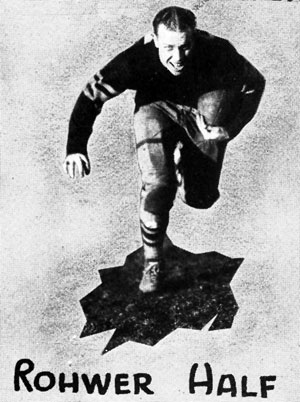
As a total aside, but to provide complete coverage on all known professional baseball players in the US with a last name of Rohwer, I know the guy to the right is related, probably a Rohwer cousin since he was in high school in Spokane while Claude and Ray were competing against each other in the PCL (I don’t have the exact information but rather genealogical references), there is also a Ted Rohwer who was a half-back at Washington State University from 1926-28 (see right). He had pitched in two games in the minors in Illinois in 1930. For his collegiate endeavors, Ted Rohwer was elected to the WSU Hall of Fame in 1989. 

Claude Rohwer, who also left the University of California to serve in WWI, and was invited to Pittsburgh Pirates training camp in 1922 only to lose the third base job to fellow prospect Pie Traynor, was done with PCL ball by 1924, became Commander of the Dixon American Legion post by 1932, and died in car accident in 1940. Ray lived until 1988, passing away in Davis, California. Even though having a game with no at-bats but four walks is unique, Ray had an even more unique game on August 23, 1927, when his Sacramento team was visiting Los Angeles. Ray went 0-0 again, but had 4 sacrifice hits, 1 walk and 1 HBP.

Also of note here is supposedly only the third ball ever hit out over the right field fence by a right handed hitter. I’ve been looking for a picture of the field from that time to gauge an idea of the size of the park. Also, I haven’t been able to find a game description of either Kamm’s or Meusel’s home runs, but I’m searching. Once again, hot off the presses of the Seattle Daily Times, from one of up to seven daily editions, a transcription of a dusty, faded day:


Indians Continue To Bunch Their Hits To Beat Sacramento
Bowman Drives Out Homer Clearing Right Field Wall for One of Longest Blows in Seattle’s History


THREE straight for the Seattle tribe of Indians is the score today in this first series at home with Sacramento as the result of a finely pitched ball game turned in by George Steuland and some more lusty hitting by his mates. The score was Seattle, 9; Sacramento, 1.
     Steuland now ranks with Suds Sutherland for the honor of the best pitched games of the year. Suds held Los Angeles to one run in the Sunday doubleheader there.
     Steuland pitched a beautiful game. And his mates backed him up in perfect style, nary a bobble occurring behind him while a snappy double play he engineered with Sam Crane and Bowman in the first inning helped him out of one of the two holes he got into by putting the first man on base.

Stingy With Hits
     The big Dakotan allowed but six hits. Kopp singled as first man up and was snagged in that aforementioned double play. Cochrane walked in the second, but he got no further,   Mollwitz and McNeeley lifting towering flies.
     Hughes singled as second man in the third inning, but Kopp lofted to Ray Rohwer and Claude Rohwer fanned on three pitched balls, two beautiful tantalizing curves and a fast one through the heart.
     Steuland balked the only run in for Sacramento in the fourth. Siglin walked, advanced on an infield out and then Cochrane also walked, Mollwitz forced Cochrane, Siglin taking third and the pair started a double steal. Steuland gave Mollwitz a big lead, stopped his pitch and threw to get Siglin, who was allowed to score unmolested. McNeeley grounded out to end that trouble.
     Steuland retired the side in the fifth, seventh and eighth. He had two men on from singles in the sixth, but fanned Mollwitz for the third out. Cochrane and McNeeley singled in the ninth, but Schang, sent in as a pinch-hitter, lofted to Ray Rohwer and the victory was won.

Just One Hit Wasted
     For the third straight game the Indians made every hit but one count. Eldred’s long double to right was wasted in the third inning. The nine other Indian bingles figured in the run getting some way.
     Bill Hughes, who was chosen to take the punishment by Manager Charley Pick, was hit for a single by Billy Lane in the first inning. Cliff Brady bunted foul on the first ball, then with the Solon infield expecting him to bunt again, singled sharply to left field. Crane did bunt and the two midgets advanced a base each.
     Brick Eldred sent a long fly to Cochrane, on which Lane scored and Brady took third. Then came the hit de luxe, Bowman’s homer over the right center field fence.
     Seattle fans who have attended baseball games in Coast League park regurlarly for years have seen just three balls hit over that fence by right-handed hitters- Bob Meusel, when he was with Vernon; Willie Kamm when he was with San Francisco and then Bowman’s yesterday. There have been flies dropped over the fence close to the foul line, but Bowman’s drive cleared the Shell Oil Company’s sign in right center, traveling on a line and clearing the wall with yards to spare. It was some drive.
     Hughes pitched nice ball from then on to the seventh, only Eldred’s double and bases on balls to Bowman and Rohwer in the third and a walk to Rohwer in the sixth marring his work.
     The Indians came back with another of the irresistible rallies in the seventh. Steuland was out when Lane doubled to left. He stole third and scored when Koehler threw into left field.
    Brady then walked and Sam Crane singled. Eldred forced Crane. Brady reaching third and scoring when Claude Rohwer kicked Bowman’s ground ball. Hughes walked Ray Rohwer for the fourth time and Ted Baldwin, whose hitting eye had been missing all week came through with a looping single to right, scoring Brick and Bowman.
     Steuland’s line single to center, Lane’s blow to left, Brady’s sacrifice and Crane’s double would the Indian scoring in the eighth.

Fans Following Play
     Another good week day crowd was on hand and with good weather on tap today and tomorrow the Coast League park is going to be taxed to the limit.
     It has been many years since Seattle has boasted of a club with a scoring record of 120 runs in sixteen games, a fielding record of only seventeen errors in sixteen games, eight of which have been played perfectly.
     And, with good pitching apparently on the road following the showings of Sutherland, Gregg, Plummer and Steuland the outlook is promising to say the least.

Lane and Rohwer Stand Out
     The work of Billy Lane and Ray Rohwer since the team returned home has been little less than phenomenal.
     Wednesday Lane hit three doubles, drew two walks and scored three runs.
     Thursday he singled twice, doubled and sacrificed, scoring two runs in five trips to the plate.
     Friday he singled twice, doubled and scored three runs.
     That makes his total nine hits, five of them doubles, and eight runs for the three games.
     Ray Rohwer on Wednesday sacrificed, singled and scored a run in four trips to the plate.
     On Thursday he tripled twice, singled twice and walked in five trips beside scoring twice.
     And yesterday he walked every time he came up, four in all.
     His record shows five hits, two of them triples, five bases on balls and a sacrifice hit as well as three runs.
     Yesterday he handled six fly balls in left field too.
     No wonder they’re winning games.

The images of the Rohwer brothers are from the Dixon Public Library's digital archives and exhibitions. Follow the pic's to link to that. Support Public Libraries!