Satchel Paige and integrated baseball in North Dakota in the 1930s
I love stories about things like the House of David (and their Jewish counterparts) because they demonstrate that, most often, semi-pro baseball was about competition in some fundamental, Adam Smith's Baker-kind-of-way, fun and money, the story of the Bismarck Churchill's is a great read or even listen, and essential for understanding the complexity of the history of race, ethnicity, segregation, and integration across all of American society. I'm still putting together a post on Japanese baseball in the West in the early 20th Century, which I hope to post soon. One of the most striking things about reading a large number of early newspapers is breaking down how often these different communities and businesses played each other and together on the ball fields. The mostly end, at least legal, of segregation in America was engineered at the 'high' level by Thurgood Marshall and NAACP legal team, working for 30 years to build precedence that would create Brown vs. Board of Education. The rest of it, the real part that made integration stick (and probably, in a paradoxical way, keeps it going), where the true momentum came from, the change that was beyond the law and in the mind of America, was from the ball fields, dance halls and factory floors.
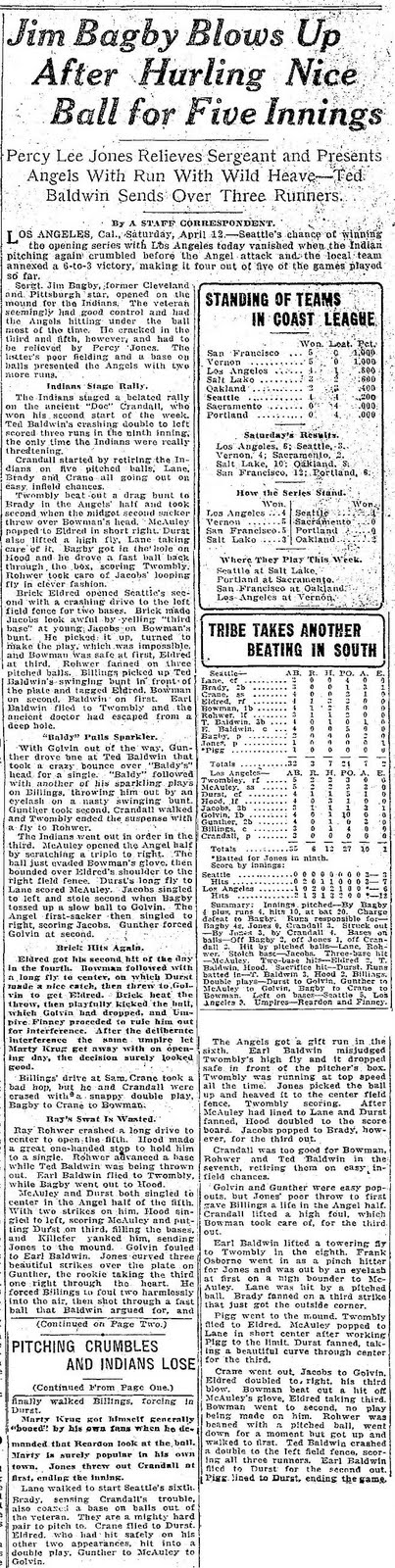
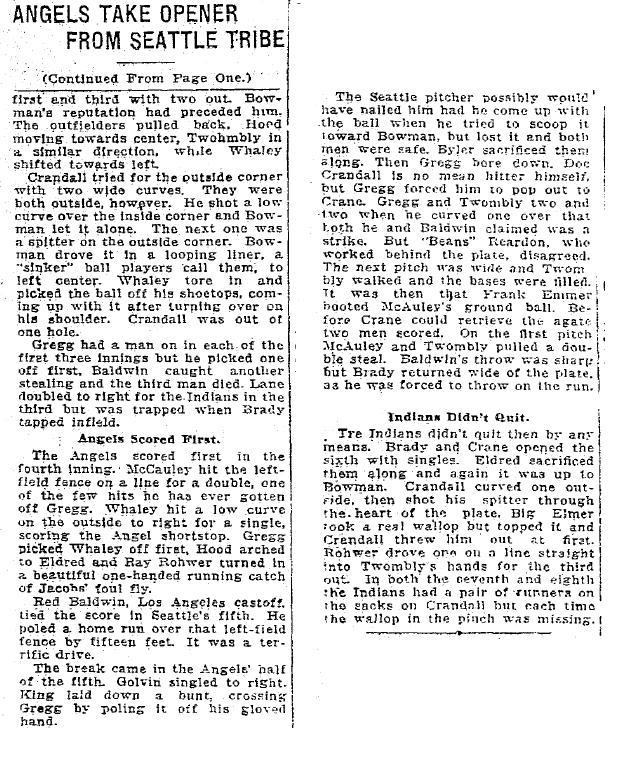
Games 6 and 7, April 13, 1924
The Seattle Steelheads
If you can find it at the Seattle Public Library, Lyle Kenai Wilson wrote an out of print book called Sunday Afternoons at Garfield Park: Seattle Black Baseball Teams, 1911-1951. And...for further reading, check out Powell S. Barnett, a resident of Seattle's Leschi neighborhood way back when. Barnett was one of Seattle's early Black baseball players. Many of these players were the children of miners who had been brought in to replace striking miners in Roslyn. This would eventually become one of the earliest integrated unions and form the core of Seattle's black community. Wilson's book, along with Esther Hall Mumford's Seattle's Black Victorians and The Forging of a Black Community: Seattle's Central District, from 1870 Through the Civil Rights Era by Quintard Taylor, give a nice overview of these communities, and we can glean from small passages in the latter two, the importance of baseball as a community activity. Wilson relates a game at Seattle's Woodland Park between a Japanese team and one of Seattle's earliest known Black teams that attracted 4,000 fans. Taylor mentions baseball exhibitions being held as part of the festivities to celebrate the visits of Marcus Garvey for UNIA rallies in 1919 and 1922. Garvey even mentions baseball in his earliest autobiography. Read about the Rev. James Morris Webb and his influence on Garveyites and Rastafari. And that's how the Roslyn Miners Strike of 1888, baseball and Bob Marley's Exodus album all fit together in the Lipstick Traces of radical history (that reference has no relation to baseball!). One more of baseball's ties to the history of radical politics and the struggle for freedom. I had posted pictures awhile back of some Bulgarian anarchists and articles about Japanese baseball. Still to come: the links between Ivy League educational ideas about athletics and staying fit, the roots of Japanese college baseball, and anarcho-syndicalism via Isoo Abe, who brought two things to Waseda University in Japan when he finished studying at the Hartford Theological Seminary in Connecticut: socialism and baseball.
Game 5, Saturday, April 12, 1924
Watch Corbally's Kuay Team
Parker McAllister was a staff illustrator at the Seattle Times for 30 years, working from 1924-1965. He was born in Massachusetts in 1903, and died in Arizona in 1970. This drawing is one of the first he did for the Times, maybe the first, not quite sure about that. McAllister painted more than 1,000 covers for the weekly Seattle Times Magazine, mostly concentrating in the later years, after World War II, on historical scenes. At that time, the Seattle Daily Times was one of the first papers to employ regular color sections and covers. These were done in four-color process, with McAllister preparing his own plates from photographs he would take at various locations around the state of Washington. These images were combined with content from staff writer Lucile McDonald, who was a groundbreaking journalist/historian. She wrote 20 or more books, but a good one to start with is her own story. The reproductions of McAllister watercolors and oils were meant to highlight Washington on the 100th anniversary of becoming a territory. Eventually, the series was called "100 Years Ago" and grew to cover nearly every square inch of the State, with some being combined into a book called "Washington's Yesterdays". More to come on McAllister's artwork. He was a master and deserves greater recognition.
Game 4, Friday, April 11, 1924
The Seattle Indians picked up their first win of the 1924 season, beating the Angels 9-5 thanks to the hitting of "Henry" known as Ted "Baldy" Baldwin and the pitching of Bill Plummer. I'm sure he'll end up with more nick-names as the season moves along. Plummer, father of a Johnny Bench backup and one-time Mariner manager, had two full seasons of PCL ball in 1924 and 1925, both marred by a consistently sore arm. Otherwise records indicate he played for either Portland in 1921, or Seattle, 1923-27, from the ages of 17 to 25. Apparently, Plummer would marry the sister of Indian teammate Red Baldwin, who would be the uncle of the future Piniella predecessor. Bill Plummer would pitch his last game on August 16, 1927, being pulled in the sixth inning for a tired arm against the San Francisco Seals. 1927 would also be the year Ted Baldwin got his cup of coffee with the Phillies, the highlight of an athletic career that saw him start by playing college baseball at Swarthmore and end up playing baseball for Portland of the New England League. Red Baldwin never got a cup of coffee. His career consisted of spending at least15 years catching in the minors. One of the things I've found when researching old-time players is that they often played semi-pro ball or some type of amateur organized baseball into their 40s. Especially those who were capable of playing in the high minors to major league levels. This often missing history is usually hinted at in small press papers or community records, with notifications of games played at summer festivals or in some local league that lasts maybe a year.
Supply Laundry leads Semi Pro League
Game 3, Thursday, April 10, 1924
First Pictures of Opening Day
Game 2, April 9, 1924
In game 2, the Angels manager Marty Krug slapped out a couple of hits, 2 of 2050 he hit in a 16-year minor league career. He had two stints in the majors as well, a cup of coffee with the 1912 Boston Red Sox (where he played in a brand new Fenway Park, which opened that year on Adolph Hitler's 23rd birthday, just five days after the Titanic sank) and most of the 1922 season with the Chicago Cubs. The Cubs were managed at that time by Bill Killefer, brother of Seattle Indians manager Wade Killefer. Krug, one of 27 major league players to have been born in Germany (nearly all played before 1920), got his start at the age of 20 in the Class D Blue Grass League with the 1909 Richmond Pioneers. Reported in the April 10 edition of the Seattle Daily Times Sports Section, Robert W. Boyce, Editor.
Seattle Game 1, April 8, 1924
In the 1924 Pacific Coast League season, the Seattle Indians and the Los Angeles Angels faced off in a thrilling game at Washington Park. The Indians had just wrapped up their spring training in Los Angeles and were ready to take on the Angels on their home ground. Washington Park, nestled next to Chutes Park on Main Street between Washington and 21st, was a bustling sports venue. It was the home ground for the Angels before they made their move to LA’s Wrigley Field in 1925.
The Seattle Daily Times covered the game in detail in its April 9, 1924 issue. Fans in Seattle had the opportunity to follow the game ‘live’ through an automatic ‘player’ displayed outside the Times’ offices in Seattle’s Times Square, facing 5th Avenue at Stewart.
The game was a duel between two seasoned pitchers, Vean Gregg for Seattle and Otis Crandall for Los Angeles. Both pitchers showcased their skills in a beautifully pitched ball game. The Angels emerged victorious with a score of 5 to 1, a victory witnessed by a crowd of 10,364 spectators.
Crandall’s victory came when Gregg’s defense faltered once. Frank Emmer, who was substituting for the injured Ted Baldwin at third base for the Indians, misjudged a hit from Flea McAuley. This allowed two runs to score and set the stage for a double steal that brought in a third run.
Despite this setback, the Seattle team managed to get eleven hits off the Angel veteran, while the Angels got nine off Gregg and Bill Plummer, who relieved the southpaw. Each team had one walk, so honors were virtually even.
The pitchers’ battle was a sight to behold. They appeared to be in midseason form, working the corners of the plate with balls not too good to hit, and mixing their curves, fast ones, and change of pace in pretty shape. They were best in the pinches, easing along when there were no men on bases, and slowing their work when men got on.
Seattle set the stage for a score early when Brady singled sharply to left. However, the Indians didn’t quit after the Angels’ scoring spree. Brady and Crane opened the sixth with singles, but the necessary hit in the pinch was missing. Despite the loss, the game was a testament to the skill and determination of both teams. It was a memorable start to the 1924 Pacific Coast League season.
In the 1924 Pacific Coast League season, the Seattle Indians and the Los Angeles Angels faced off in a thrilling game at Washington Park. The Indians had just wrapped up their spring training in Los Angeles and were ready to take on the Angels on their home ground. Washington Park, nestled next to Chutes Park on Main Street between Washington and 21st, was a bustling sports venue. It was the home ground for the Angels before they made their move to LA’s Wrigley Field in 1925.
The Seattle Daily Times covered the game in detail in its April 9, 1924 issue. Fans in Seattle had the opportunity to follow the game ‘live’ through an automatic ‘player’ displayed outside the Times’ offices in Seattle’s Times Square, facing 5th Avenue at Stewart.
The game was a duel between two seasoned pitchers, Vean Gregg for Seattle and Otis Crandall for Los Angeles. Both pitchers showcased their skills in a beautifully pitched ball game. The Angels emerged victorious with a score of 5 to 1, a victory witnessed by a crowd of 10,364 spectators.
Crandall’s victory came when Gregg’s defense faltered once. Frank Emmer, who was substituting for the injured Ted Baldwin at third base for the Indians, misjudged a hit from Flea McAuley. This allowed two runs to score and set the stage for a double steal that brought in a third run.
Despite this setback, the Seattle team managed to get eleven hits off the Angel veteran, while the Angels got nine off Gregg and Bill Plummer, who relieved the southpaw. Each team had one walk, so honors were virtually even.
The pitchers’ battle was a sight to behold. They appeared to be in midseason form, working the corners of the plate with balls not too good to hit, and mixing their curves, fast ones, and change of pace in pretty shape. They were best in the pinches, easing along when there were no men on bases, and slowing their work when men got on.
Seattle set the stage for a score early when Brady singled sharply to left. However, the Indians didn’t quit after the Angels’ scoring spree. Brady and Crane opened the sixth with singles, but the necessary hit in the pinch was missing. Despite the loss, the game was a testament to the skill and determination of both teams. It was a memorable start to the 1924 Pacific Coast League season.
University of Washington Baseball Team tours Japan, 1908
The UW was the first American university team to tour Japan. Japan's Waseda University baseball team had visited Seattle in 1904, playing a local club, as well as the UW. More info and source here.
Bulgarian Anarchy, March 12, 1924
No Major League player has ever come from Bulgaria, but they do play baseball there. Articles like this make me think the presence of anarchy is often overstated.
Spring Training Begins, Monday, March 10, 1924
1924 Pacific Coast League
That year, the Seattle Indians would field 33 different players during the season, 20 of whom would see, or had seen, at least a cup of coffee in the majors. They won the 1924 PCL title, finishing 109-91. Playing a 200 game season was common for the PCL at that time, more on that later. Eight players had over 150 hits for the Indians that year, and the leaders in games played were Henry Baldwin with 196 and Cliff Brady with 194. Seven others would play over 149 ball games. Behind the plate, they had Earl 'Red' Baldwin, who would catch 155 games that year, the most of any of his 14 PCL seasons. Earl was such a talented catcher, no mention is even made of future Hall of Famer Mickey Cochrane until the second to last paragraph in this preseason article from the Wednesday, April 2, 1924, edition of the Seattle Daily Times sports pages.
Introducing Coast League Newcomers, January 26, 1924
Born Paterson, N. J., September 14, 1901; height 5 feet 11 1/2 inches; weight 189 pounds. Throws right handed. Bats both ways.
First engagement- Clovis, Panhandle-Pecos Valley League, 1923. Finished season with Vernon.
1923 record- Won 19 games and lost 13; percentage, .594. Batted .287 and fielded .975.
Pitched 37 innings with Vernon, winning one game and losing two.
The Missing Spark Plug
Billy Lane, Seattle Star, to Be Honored Monday
Here we have him in poses grown familiar to Seattle fans through the three years little Billy has been playing with the Indians. "The Missing Spark Plug" we've named this camera story of little Bill, not because he's worn out, nor because he's refused to function. He's "The Missing Spark Plug" because a pitched ball hit him in the head, fractured his skull and forced his retirement for probably the rest of the season. Monday, Seattle fans and players are giving him a day - Billy Lane Day. His friends hope the Seattle ball park will be packed. The photographs show Billy's smiling face, his pose at bat, crossing first base and various sliding poses, an art at which he is so proficient that he is known as the Coast League's best base runner.
Killefer Convinced Tribe Is Strong
"When Red Killefer leads his Seattle Indians out for inspection of home fans at the Rainier Valley ball yard next month, three new members of the club, pictured above (picture not available), will be given close attention. Cliff Brady, the midget second sacker from Rochester, is expected to work into a great second base combination with Sammy Crane. George Steuland, pitcher, is the man Killefer is grooming to take the place of Elmer Jacobs. Earl Baldwin, last year with Los Angeles, is expected to give Seattle a boost in the back-stopping department."